The difference between gelato and ice cream is often assumed to be merely a matter of an Italian name versus an American one — yet the two are entirely distinct products, from the first line of the recipe all the way to the moment they melt on your palate. Whether you are a frozen dessert enthusiast or an aspiring entrepreneur looking to enter the premium market, understanding this difference determines what you sell, to whom, and at what margin.
In Indonesia, the confusion between gelato and ice cream has grown more acute as gelato shops multiply across Jakarta, Bandung, Yogyakarta, and Bali. Many write « gelato ice cream » on their store signs without truly knowing whether their product is authentic gelato or ordinary ice cream given an Italian name to appear premium. As a consumer, you deserve to know what you are buying; as a business owner, you must understand what you are selling.
This guide was developed based on the method of Mr. Jeff, creator of all La Gelato’s recipes and production procedures — including the cold process method adapted for Indonesia’s tropical climate. We will explain seven fundamental differences between gelato and ice cream in technical, honest, and no-nonsense terms.
Key Points You Need to Know
- Milk fat: gelato only 4–9%, ice cream 14–25% — gelato is lighter yet more intense in flavor.
- Air content (overrun): gelato 25–35%, ice cream 50–100% — gelato is denser and creamier.
- Serving temperature: gelato -12°C to -14°C, ice cream -18°C to -20°C — gelato is softer and its flavor registers on the tongue immediately.
- Origins: gelato was born in Italy in the 16th century, industrial ice cream developed in the United States in the 19th century.
- Calories: gelato is generally 30–40% lower in calories than ice cream for the same portion size.
Origins: Italy in the 16th Century vs the United States in the 19th Century
Before diving into technical differences, let us first understand the historical context. Gelato is Italian ice cream in the most literal sense: the product was born in Florence in the 16th century, when an artist named Bernardo Buontalenti served a frozen dessert made from milk, eggs, and fruit to the Medici family. This recipe slowly spread throughout Italian cities, becoming an artisanal tradition passed down through generations of gelatiere families for centuries.
Ice cream — in the modern, industrial form we know today — developed in the United States in the 19th century. When Jacob Fussell opened the first ice cream factory in Baltimore in 1851, he applied industrial principles: mass production, high milk fat for shelf life, high air content for cheap volume, and low storage temperatures for long-distance distribution. This is how the industrial ice cream standard was born — the standard still used today by major brands worldwide.
The consequence is clear: gelato and ice cream are not simply two names for the same product. They are built on two entirely different philosophies. Gelato is an artisanal product that prioritizes flavor, density, and freshness — usually made daily in small quantities. Ice cream is an industrial product that prioritizes volume, shelf life, and distribution — usually produced in large quantities with an extended cold chain.
Milk Fat Content: The First Fundamental Difference
This is the most technical and most frequently misunderstood difference. The Italian artisan gelato standard sets milk fat content between 4% and 9%. The US FDA standard for ice cream, by contrast, requires a minimum of 10% milk fat, and in practice many premium ice creams reach 14% to 25%.
Lower milk fat in gelato is not a weakness — quite the opposite. Excess milk fat coats your tongue and masks the flavor of the main ingredient (chocolate, pistachio, hazelnut, fresh fruit). In a gelato with 6% fat, the flavor of Piedmontese hazelnut comes through as intense, complex, and authentic. In an ice cream with 18% fat, the same hazelnut tastes « creamy » but its flavor is muffled by the fat coating.
This is also why traditional Italian gelato uses a large proportion of fresh milk and little cream, while American ice cream uses a large proportion of cream and little milk. This difference in composition determines the entire product profile: gelato focuses on flavor, ice cream focuses on creamy texture. Both are valid, but both are different — and you need to know which one you want.
A note from Mr. Jeff — Creator of Recipes & Methods
« Many Indonesians think gelato is healthier because it is « lighter ». The truth is gelato is more honest — you taste the main ingredient without fat getting in the way. This is not about healthy or not; it is about respecting flavor. »
Air Content (Overrun): The Second Difference Often Overlooked
Have you ever noticed why Italian gelato ice cream feels denser and creamier in the mouth, while supermarket ice cream feels « fluffy » and melts quickly? The answer lies in one technical term: overrun, the air content incorporated during the freezing process.
Artisan gelato has an overrun of between 25% and 35%. This means that from 1 litre of liquid mix, you obtain 1.25 to 1.35 litres of finished gelato. Industrial ice cream has an overrun of between 50% and 100%, sometimes more. From 1 litre of mix, a factory can sell 2 litres of ice cream — half of which is air.
Why does the ice cream industry use high overrun? The reason is simple: economics. Air is free. The more air inside the product, the fewer raw materials are needed for the same volume, and the higher the profit margin. From the perspective of mass producers, high overrun is a way to increase profit without raising the retail price.
The consequence for your eating experience: gelato with 30% overrun feels denser, more elastic, and the flavor of the main ingredient is more concentrated. Ice cream with 80% overrun feels lighter, melts more easily, and often gives a « mouth-filling » sensation that is really just air. For food entrepreneurs, understanding overrun is the key to defining your market positioning — premium artisan, or mass-market volume.
Serving Temperature: The Third Difference That Changes Your Palate Experience
This is the difference between ice cream and gelato that is least visible to the eye yet most noticeable on the tongue. Gelato is served at -12°C to -14°C. Ice cream is stored and served at -18°C to -20°C, sometimes colder.
That 6-degree gap is not a minor technical detail — it transforms the entire experience of consuming the product. At -18°C, ice cream is so frozen that your tongue needs several seconds to detect its flavor. During those seconds, part of the taste is lost because the extreme cold numbs some of your taste receptors.
At -13°C, gelato sits at the point where it remains firm yet soft enough to release its flavors the instant it touches your tongue. You will immediately taste Bourbon vanilla, Bronte pistachio, or 70% Valrhona chocolate at full intensity. This is why gelato feels more « alive » in the mouth, while ice cream can feel more « asleep ».
The practical consequence for business owners: if you want to sell gelato, you need a vetrina (display case) with precision temperature control at -12°C to -14°C, not a standard -20°C freezer. A simple thermal error — storing gelato at ice cream temperatures — will destroy your product quality and no customer will return. To learn more about the right equipment, read our guide on ice cream machines for the gelato business.
Want to Learn to Make Real Gelato — Not Just Italian Ice Cream?
La Gelato Academy teaches the Italian artisan method adapted for Indonesia’s tropical climate. The full package starts from Rp1.250.000 (regular price RP3JT), including lifetime access and 3 free raw material sachets delivered anywhere in Indonesia.
Texture, Flavor, and Sensation: The Fourth Difference in the Mouth
The combination of the three previous factors — low fat, low overrun, and warmer serving temperature — creates a texture and flavor experience that is markedly different in the mouth. Gelato feels velvet: dense yet soft, smooth yet not slick, with a sensation that immediately releases the aroma of the main ingredient the moment it touches your tongue.
Ice cream feels cloud-like: light, fluffy, creamy, with a texture that melts faster due to high air content and the fat that coats the mouth. This sensation makes ice cream comfortable as a traditional American dessert, but less suitable when you want to experience the flavor of an ingredient with full intensity.
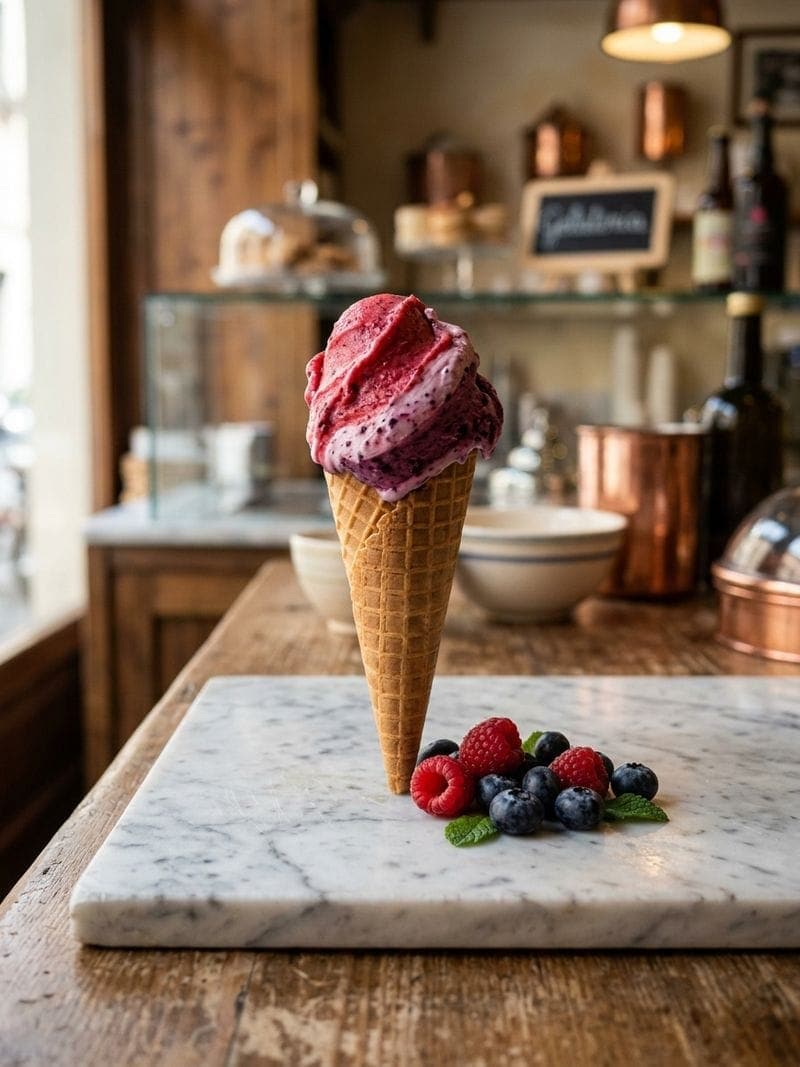
This is also why quality gelato does not rely on synthetic colorings or artificial flavors. Because its texture and temperature allow the flavor of the main ingredient to stand out naturally, artisan gelatieri rely on authentic ingredients: fresh Bronte pistachios, Piedmontese hazelnuts, fresh milk from local farms, fresh seasonal fruit blended to order. In industrial ice cream, by contrast, synthetic flavors and colorings are frequently used because the texture and temperature that blunt flavor mean that real ingredients go undetected by consumers.
Raw Materials and Production Process: The Fifth Decisive Difference
Let us step into the kitchen. A classic gelato recipe uses: fresh milk (60–70%), cream (5–10%), sugar (16–22%), skim milk powder (3–5%), and natural stabilizers (carob bean, guar). There are no eggs in classic gelato (except for the « crème » variant that uses egg yolks). These base ingredients are combined with fresh fruit purée or authentic nut paste for flavor variants.
A classic American ice cream recipe uses: cream (40–50%), milk (20–30%), sugar (12–18%), egg yolks (4–6%), industrial stabilizers (carrageenan, locust bean, mono-diglyceride). Additional ingredients typically include corn syrup, synthetic flavors, and colorings for industrial consistency.
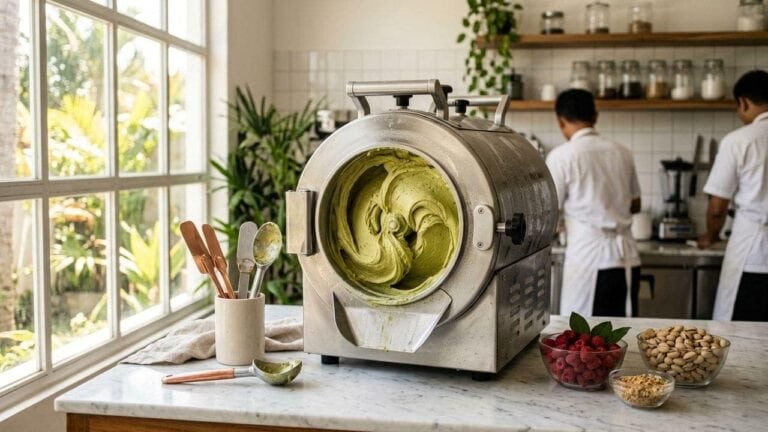
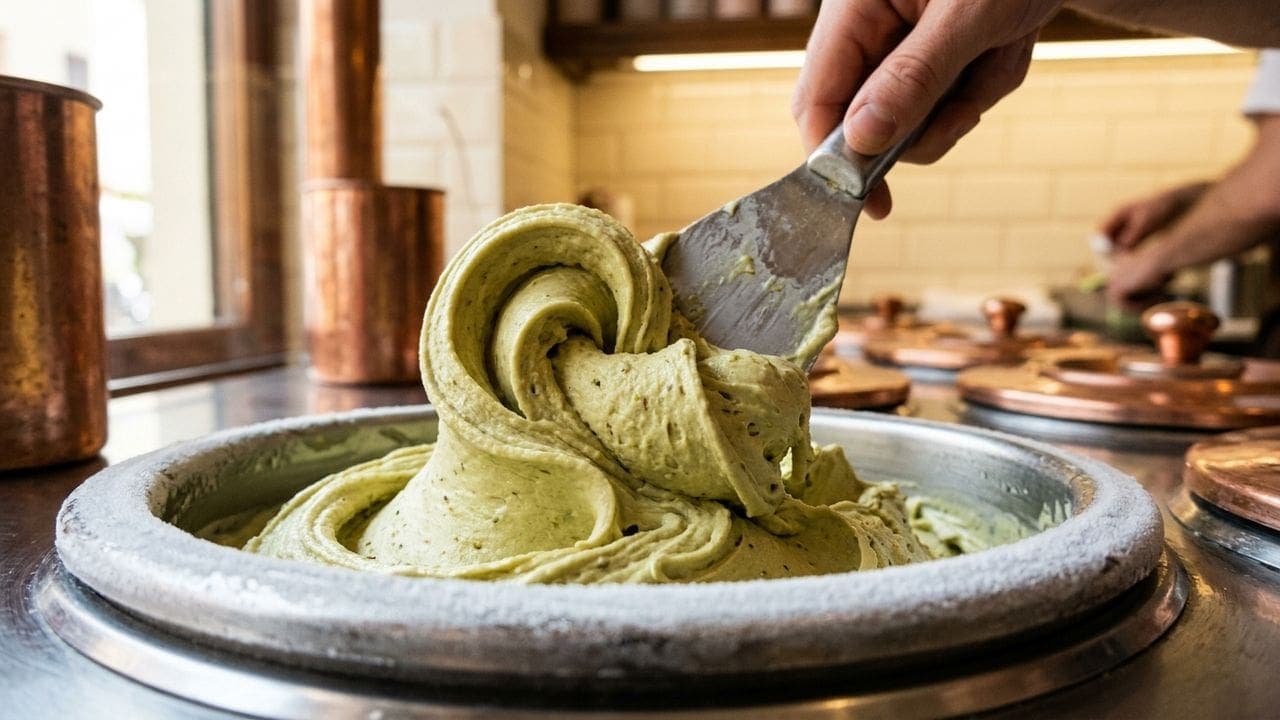
This difference in composition also affects the production process. Gelato is made at a low churning speed (around 80–100 rpm), which incorporates only a small amount of air naturally. Ice cream is made at a high churning speed (around 150–250 rpm), deliberately whipping as much air as possible into the mix. The machines used also differ structurally: artisan batch freezers designed for small daily production runs differ fundamentally from industrial continuous freezers designed for mass production.
For entrepreneurs looking to enter the premium gelato market, understanding this process is essential. You cannot make Italian-quality gelato with a cheap ice cream machine, and vice versa. Learn in a structured way through our guide how to make ice cream from a home recipe all the way to authentic Italian gelato, written for beginners through semi-professionals.
Hot Process vs Cold Process: The Sixth Difference Often Forgotten
This is the technical difference that mainstream media rarely explains yet is critically important for professionals. Most traditional gelato and ice cream recipes use the hot process: ingredients are heated to 85°C (pasteurization), cooled to 4°C (aging for 4–24 hours), then loaded into the batch freezer. This process can take 12–48 hours from start to finish.
At La Gelato Academy, we teach an alternative philosophy called cold process. The core concept: no heating and no cooling. Ingredients are mixed cold and frozen directly. The entire process from start to finished product takes only 15–30 minutes.
Our motto is simple and we hold it verbatim:
Innovation without pasteurization. No temperature gap — a more hygienic, more efficient product, through a lightning process.
Why is cold process more hygienic? Because there is no heating-cooling phase that opens a window for microbial contamination. Why more efficient? Because the production cycle time drops from 12–48 hours to 15–30 minutes, and the equipment setup is far simpler (no large industrial pasteurizer costing hundreds of millions of rupiah).
Cold process is a public method used by some practitioners in Italy. What distinguishes La Gelato is the proprietary procedure created by Mr. Jeff within the cold process framework — recipes, ratios, and a specific syrup method developed to suit Indonesia’s tropical climate and standard PLN 3.2 kW household/small-lab electricity.
Price, Calories, and the Halal Aspect: The Seventh Practical Difference
Let us come down to the aspects you experience most directly as a consumer — or calculate most carefully as a prospective entrepreneur. The price difference between gelato and ice cream in Indonesia is quite significant: premium gelato at a gelato shop in Jakarta or Bali typically sells for Rp 35,000–Rp 65,000 per scoop. Premium ice cream at supermarkets typically sells for Rp 60,000–Rp 120,000 per pint (480 ml), or Rp 12,000–Rp 25,000 per scoop.
The calorie difference: gelato is generally 30–40% lower in calories than ice cream for the same portion, because of its lower fat and lower air content (meaning one scoop of gelato weighs more than one scoop of ice cream, yet its total calorie count remains lower). As a rough guide: a 100 g scoop of gelato ≈ 200 kcal; a 100 g scoop of ice cream ≈ 280–320 kcal.
The halal aspect is a primary consideration in Indonesia. Many imported ice creams contain pork gelatin or alcohol as a stabilizer, rendering them non-halal. Artisan gelato made in Indonesia with local ingredients and BPJPH/MUI certification can be fully halal — La Gelato Academy teaches HALAL-by-design formulation using plant-based stabilizers (carob, guar) with no non-halal animal derivatives.
| Criterion | Artisan Gelato | Industrial Ice Cream |
|---|---|---|
| Origins | Italy, 16th century | United States, 19th century |
| Milk fat | 4–9% | 14–25% |
| Overrun (air) | 25–35% | 50–100% |
| Serving temperature | -12°C to -14°C | -18°C to -20°C |
| Texture | Dense, velvet, intense | Light, fluffy, creamy |
| Calories per 100g | ~200 kcal | 280–320 kcal |
| Price in Indonesia | Rp 35,000–65,000 per scoop | Rp 12,000–25,000 per scoop |
A note from Mr. Jeff — Creator of Recipes & Methods
« Many Indonesians want to enter the ice cream business because the market seems large. But a large market means fierce competition and thin margins. The gelato market is smaller — but its customers are willing to pay 2–3× the price of ice cream for a more honest product. This is simple mathematics that smart entrepreneurs understand. »
Business Implications in the Indonesian Market: When to Choose Gelato, When to Choose Ice Cream
A question our prospective students frequently ask: « Should I sell ice cream or gelato? » Our answer is always: it depends on your positioning. Both products are valid, but they target different markets.
Choose ice cream if: your target is high volume with thin margins, your location is in a suburban area or region with lower-to-middle purchasing power, your model is supplying cafés, restaurants, or convenience stores, and your equipment budget is under Rp 50 million. In this context, cost structure and operations are simpler, but you must be prepared to compete on price with large industrial brands.
Choose gelato if: your target is a premium niche with high margins, your location is in a tier-1 city or premium tourist destination (South Jakarta, Bali, central Yogyakarta), your model is a direct-to-consumer gelato shop, and you are ready to invest Rp 80–200 million in Italian-grade artisan equipment. Gelato margins can reach 60–75% per scoop, compared to 20–35% for industrial ice cream.
Many of our students also choose a third path: a gelato franchise model that we have systematized — a business proven through the razor-blade approach we explain in our guide on gelato franchise in Indonesia with La Gelato’s razor-blade system. For those interested in formal training, check our guide on gelato courses in Indonesia or ice cream courses in Indonesia to compare learning pathways.
Frequently Asked Questions About Gelato vs Ice Cream
Is gelato the same as Italian ice cream?
Yes, literally speaking gelato is Italian ice cream because « gelato » in Italian means « ice cream ». But in international terminology and the culinary industry, « gelato » specifically refers to the Italian artisan product with low milk fat (4–9%), low overrun (25–35%), and a serving temperature of -12°C to -14°C. « Ice cream » refers to the American industrial product with high fat, high overrun, and a colder temperature. So gelato is Italian ice cream, but not all ice cream is gelato.
Why is gelato more expensive than ice cream in Indonesia?
There are four reasons. First, gelato uses premium raw materials (Bronte pistachios, Piedmontese hazelnuts, fresh daily milk) rather than cheap industrial ingredients. Second, low overrun means more ingredients per litre of product. Third, gelato is made in small daily quantities, so the labour cost per unit is higher. Fourth, Italian artisan batch freezer equipment is more expensive than industrial continuous freezers. This combination explains the 2–3× higher price.
Is gelato healthier than ice cream?
Generally speaking, gelato is 30–40% lower in calories than ice cream for the same portion size, because of its lower milk fat and lower air content. But « healthier » depends on your definition — premium gelato still contains high sugar (16–22%) and dairy, so it is not a health food. It is more accurate to describe gelato as a more honest and lighter dessert, not a healthy dessert. For a truly low-calorie option, choose sorbet (even lower because it contains no dairy).
What is the difference between gelato and sorbet?
Gelato is dairy-based; sorbet is made from fruit and water with no dairy. Sorbet is typically offered as a vegan and halal-safe option because it contains no animal-derived ingredients. Its texture is lighter and fresher, with the lowest calorie count of the three products (gelato vs ice cream vs sorbet). Many premium gelato shops serve both side by side to cater to vegan and lactose-intolerant customers.
Is gelato halal in Indonesia?
Gelato made with halal ingredients and certified by BPJPH/MUI is fully halal. The key lies in stabilizers and emulsifiers — use plant-based stabilizers (carob bean, guar gum) rather than animal-derived gelatin. La Gelato Academy teaches HALAL-by-design formulation using raw materials already certified by MUI. Imported ice cream, by contrast, is often not halal because it uses pork gelatin or alcohol as a stabilizer. Always check the certification label before purchasing.
Can I make gelato at home with a regular freezer?
You can, but the result will be far from authentic artisan gelato. A household freezer only lowers the temperature (around -18°C) without churning during freezing, so large ice crystals form and the texture becomes hard and grainy. For results approaching artisan gelato, you need a home ice cream maker with churning capability. For professional gelato-shop results, you need an artisan batch freezer capable of simultaneously freezing and churning at precisely controlled speed and temperature.
Still Unsure Whether to Choose Gelato or Ice Cream for Your Business?
Discuss your business plan free for 15–30 minutes with the La Gelato Academy team. We will help you choose the path that best fits your situation, capital, and target market — no pressure, no commitment.
Free consultation — No commitment — Fast WhatsApp response
Conclusion: Seven Fundamental Differences You Now Understand
You now understand that the difference between gelato and ice cream is far more than a gap between an Italian and an American name. The seven fundamental differences — origins, milk fat, overrun, serving temperature, texture, raw materials, and process philosophy (hot vs cold) — define two products that are profoundly distinct in flavor, texture, price, and target market. Both are valid; what matters is that you know which one you want, whether as a consumer or as an entrepreneur.
For those considering entering Indonesia’s premium frozen dessert market, artisan gelato offers higher margins, a premium positioning that is difficult for large industrial brands to disrupt, and more loyal customers because they are paying for quality they can actually taste. To enter this space in a structured way, La Gelato Academy offers a purpose-built course that covers the recipes, methods, and operations of artisan gelato — including the proprietary cold process method we developed for Indonesia’s climate and electricity standards.
Innovation without pasteurization. No temperature gap — a more hygienic, more efficient product, through a lightning process.
7-day money-back guarantee if you have not yet attended the hands-on workshop in Yogyakarta and have not completed more than 30% of the online content — we believe in what we teach, and you deserve to be confident before committing.
About the Creator
Mr. Jeff
Holder of a diploma in artisan glacier from Italy, with years of experience developing recipes and methods in a real production laboratory. Creator of all La Gelato’s recipes, methods, and production procedures — including the proprietary cold process method adapted for Indonesia’s tropical climate and the standard PLN 3.2 kW electricity found in homes and small labs. Every formulation was developed and tested over months before being incorporated into the curriculum.
The philosophy he embedded in the La Gelato Academy curriculum is simple: knowledge shared honestly is the path to a business built with integrity. Every recipe taught at La Gelato Academy has passed dogfooding — tested for real in our own laboratory in Yogyakarta before reaching course participants.
The same dogfooding approach runs through the entire La Gelato ecosystem: the training academy (lagelatoacademy.com), the B2B raw material factory, and the franchise program (la-gelato.com). Every component of the system offered to students or partners has been tested for real before being shared.