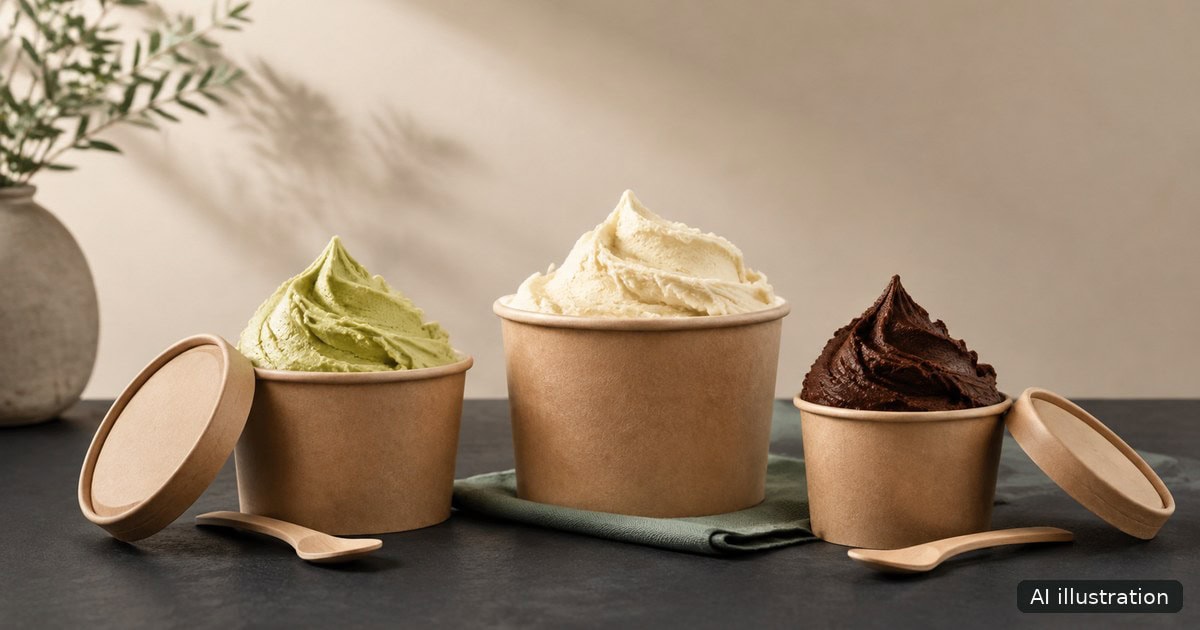
Ice cream packaging for business should be chosen on the basis of the service flow, not on appearance alone. A cup that works well at the counter may not suit takeaway, while a lidded container may not remain practical inside a delivery bag. The deciding factor is the fit between the product, portion, service time, storage and customer experience.
This guide helps you make the decision step by step. No single material or size is automatically best for every business. Ask suppliers for specifications, test samples with your own product and process, and record the result before placing a large order.
Key points
- Start with how the product is served: counter, takeaway, pre-order or delivery.
- Test the cup, lid, spoon, label and bag as one system, not as separate items.
- Use a reference portion and simple records so packaging supports consistency and margin.
Start with the service model, not the catalogue
Before comparing shapes or colours, write down how customers receive the product. Is the gelato eaten immediately at the counter? Are most orders taken away? Do you prepare family tubs, pre-orders or deliveries that pass through a courier?
Each route needs a different combination. Counter service prioritises speed and comfort while eating. Takeaway needs a compatible lid and a stable arrangement. Delivery adds the bag, separate accessories, order identification and a realistic time boundary. If your model is still unclear, begin with the guide to understanding an ice cream business model before locking in the packaging.
Define a purpose for each packaging format
For immediate counter service
Choose a container that is easy to hold, does not obstruct the spoon and leaves appropriate room for the portion and toppings you actually sell. Operators should be able to take one cup quickly without causing the rest of the stack to fall or stick together.
For takeaway
Test the container and lid as a pair. Check whether the lid can be fitted with a consistent movement, remains stable inside the bag and does not press excessively on the product. A label should not be used to compensate for a lid that does not fit properly.
For delivery or a longer journey
Assess the full journey: from the showcase or production area to the packing table, into the bag and finally to the customer. Packaging is only one part of that chain. Time, product condition when packed, bag arrangement and customer communication still need to be managed as one process.
Five minimum requirements before choosing
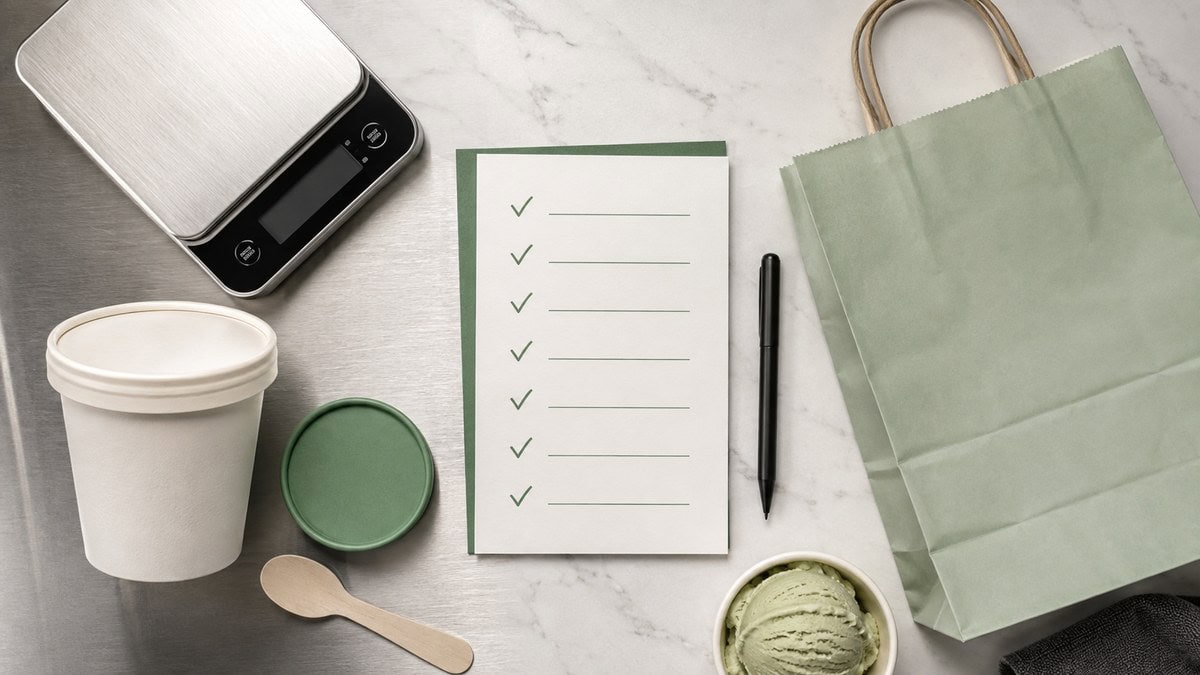
- Fit for purpose. Separate formats for immediate service, takeaway and short storage.
- Easy for operators. Cups and lids should be easy to take, fill, close, identify and hand over without unnecessary steps.
- Consistent with the portion. The container should help the team repeat the reference portion rather than encourage unrecorded additions.
- Available for testing. A supplier should be able to provide or sell samples before a large order. Ask for specifications that match your intended use.
- Compatible with stock control. Consider storage space, the number of variants, lead time and the risk of running out of one component such as a lid.
How to test ice cream packaging for business
Run a small test with the real product. Use the reference portion, usual toppings, intended spoon, order label and the bag that will actually be available. Do not assess an empty cup in isolation.
Repeat the service simulation several times. Record filling time, ease of closing, stability while carried, changes in the container, workstation cleanliness and operator feedback. For takeaway, complete a short route that resembles a customer journey. The objective is not to find perfect packaging, but the most consistent system for your context.
Also test what happens after service. Where are the cups stored? Can lids be identified quickly? How is stock counted? Does leftover packaging interfere with cleaning? The guide to cleaning an ice cream machine shows why packaging and hygiene need to fit into the same working rhythm.
Want to build a more disciplined production flow?
Learn the foundations of gelato recipes, production, service and operations for the Indonesian market.
Explore the gelato courseProtect portion and cost consistency
Packaging affects how the team perceives a portion. Two containers with a similar stated capacity can look different when filled, especially if one is tall, wide or narrow at the base. Do not rely on visual impression alone.
Set one reference portion for every format you plan to sell. Weigh the result several times, record the toppings, then compare service speed and presentation. This small data set helps you understand cost per order without changing the recipe or price at random. If variation is too wide, improve the serving tool, sequence or operator training before adding another size.
Add branding after the function has passed
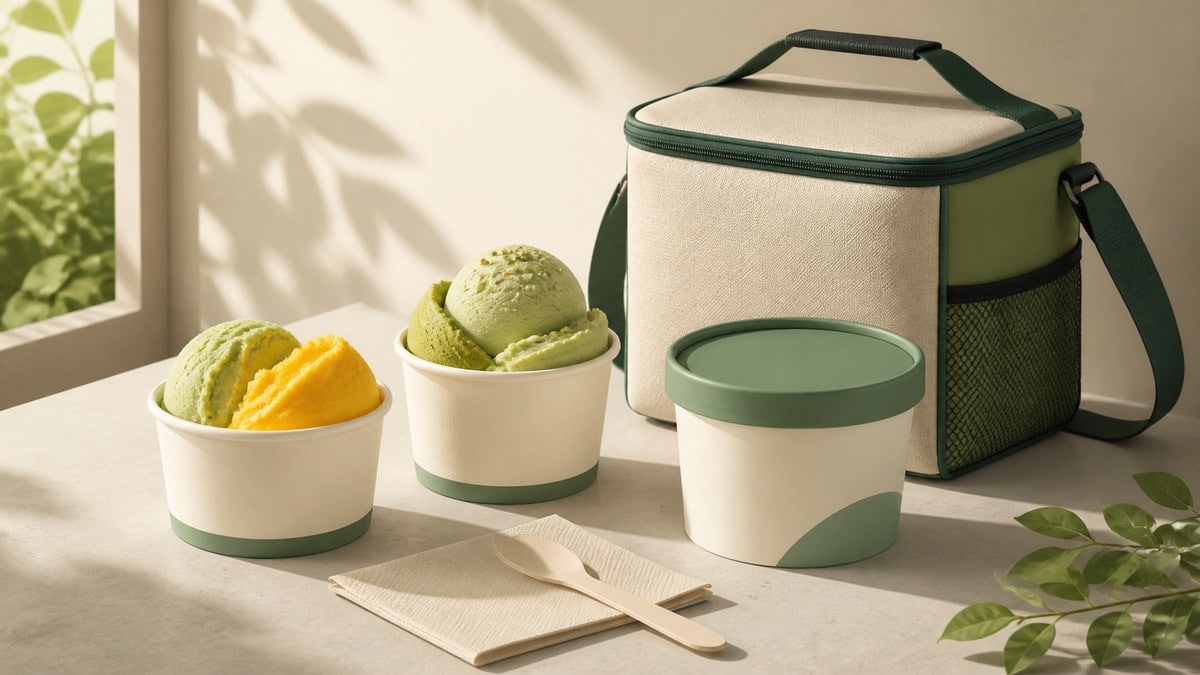
A logo, colour and short message can make the packaging easier to recognise. However, design comes only after the basic function has passed its test. Plain stock packaging with a simple label can be a sensible starting point while volume is still unstable. It lets you adjust the size, lid or service flow without being left with a large quantity of unsuitable printed packaging.
Make sure the brand name remains readable at a realistic distance and on the smallest format. Before ordering printed packaging, validate the identity with the checklist for choosing an ice cream business name. A premium brand is built through product and service consistency, not through crowded packaging.
A simple decision map
| Business situation | First priority | Test to run |
|---|---|---|
| Counter with immediate consumption | Service speed and comfort while eating | Portion, grip, spoon and queue flow |
| Takeaway-led business | Cup, lid, label and bag compatibility | Repeated closing, bag arrangement and a short journey |
| Pre-order or family tubs | Identification, storage and handover | Order labels, stock arrangement and customer instructions |
| New business with unstable volume | Flexibility and simple stock | Samples, one or two formats, then review before custom print |
Common mistakes
- Choosing from catalogue photos. A photo does not show how the container works with your product and operator.
- Ordering too many variants. Every size adds lids, stock, labels, space and another opportunity to pick the wrong item.
- Printing too early. A finished design can lock in a format that has not passed the practical test.
- Testing the cup without the lid and bag. Problems often appear between components.
- Not recording results. Without a record, the team returns to decisions based on impressions.
Final checklist before ordering
- The service route for every format is defined.
- Samples have been tested with the real product, portion, toppings, spoon, lid, label and bag.
- Operators can use the packaging without confusing steps.
- The reference portion and checking method are written down.
- Storage space, lead time and cup–lid pairs are mapped.
- Supplier specifications for the intended use have been requested and stored.
- Custom printing is considered only after the size and workflow are stable.
Frequently asked questions about ice cream packaging for business
Are paper cups always better for gelato?
No single option is always best. Define the purpose, service flow, supplier specifications and test result with your product first.
How many cup sizes should a new business offer?
Start with a small number of clear formats. One or two repeatable portions are usually easier to manage than many variants from day one.
Does a small business need custom-printed cups immediately?
Not necessarily. Plain cups with a neat label provide flexibility until the size, volume and brand identity are stable.
What should be tested before a large order?
Test the portion, lid, spoon, label, bag, operator speed, takeaway journey, stock storage and ease of recording.
Conclusion
Choosing ice cream packaging for business is an operational decision. Start with the service model, limit variations, test the entire system, and use portion and stock records to decide. Once the function is proven, branding and larger orders become more reasonable steps.
Ready to organise your gelato project?
Discuss training and operational foundations suited to your business plan.
Contact La Gelato