Gelato vs ice cream — the difference is actually something you can spot in seconds, even before the first spoonful. Many people assume they’re the same thing, just with different names. Yet there are visible signs at the display case, on the spoon, and on your palate that immediately set artisan gelato apart from ordinary ice cream.
Recognizing these differences is useful for two things: so you know what you’re actually paying for when you buy, and — if you’re planning a business — so you understand exactly what kind of product you want to sell. Both categories stem from completely different production logic.
In this article, our instructor team at La Gelato Academy summarizes the 5 fastest signs to tell gelato and ice cream apart, with the technical reasons behind each one. The cold process method we use as our reference was developed by Mr. Jeff, adapted specifically for Indonesia’s tropical climate.
Key Points to Know
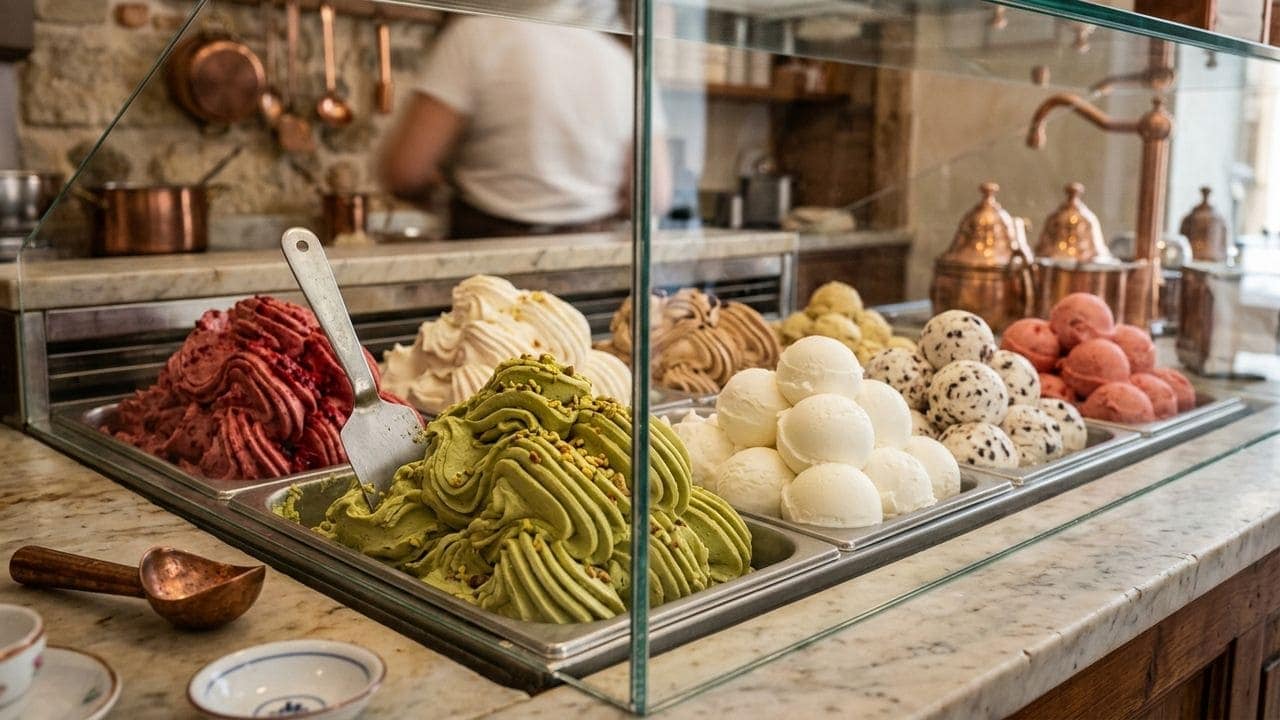
- Gelato is served “warmer” at -11°C to -14°C vs ice cream at -18°C — it looks softer and glossier in the display case
- Gelato’s air content (overrun) is only 20–30% vs ice cream’s 50–100% — denser texture and heavier per spoonful
- Gelato’s fat content is 6–8% vs ice cream’s 14–16% — the flavor hits your palate more intensely and directly
- Gelato is typically scooped with a spatula and arranged in waves, while ordinary ice cream is scooped into a round ball
- For a business, La Gelato cold process gelato can be started from ≈ $1,400 (Rp 24,9 juta) — no pasteurizer needed, standard residential PLN power of 3.2 kW is enough
Why Is the Difference Between Gelato and Ice Cream So Often Confusing?
In Indonesia, the words “gelato” and “ice cream” are often used interchangeably, especially in shops that sell both in the same display case. Visually they do look similar: both are cold, sweet, and served in a cup or cone. It’s no surprise many buyers consider them just two names for the same product.
Yet gelato and ice cream start from fundamentally different recipes and technical standards. Gelato originates from Italy, made with a lower fat content and less air injected during freezing. Ice cream — especially industrial brands — uses more high-fat cream and more air, making it feel lighter and airier.
The good news is you don’t need to be an expert to tell them apart. Once you know what to look for, gelato vs ice cream becomes obvious immediately — from how the product is displayed to the sensation on your first spoonful. Here are the five easiest signs to recognize.
5 Quick Signs to Recognize Gelato vs Ice Cream
Before diving into the technical explanation, here’s a summary of five signs you can use directly in the field — at a shop, supermarket, or when choosing a product for your business:
| Sign | Artisan Gelato | Industrial Ice Cream |
|---|---|---|
| 1. Temperature & appearance | -11°C to -14°C — looks soft, glossy | -18°C — looks more frozen and firm |
| 2. Serving style | Scooped with a spatula, arranged in waves | Scooped into a round ball with an ice cream scoop |
| 3. Texture on the spoon | Dense, heavy, creamy (overrun 20–30%) | Light, airy (overrun 50–100%) |
| 4. Color | Tends to look natural, not overly vivid | Often brighter and more vivid |
| 5. Flavor on the palate | Intense, hits directly (fat 6–8%) | Lighter, fatty sensation (fat 14–16%) |
Not all signs need to appear at once — but if three or more match the gelato column, you’re most likely looking at artisan gelato, not ordinary ice cream. Let’s go through the reasoning one by one.
The Difference at the Display Case: Serving Temperature and Presentation
The first and most immediately visible sign is at the display case, even before you order. Gelato is served at -11°C to -14°C, while ordinary ice cream is stored and served colder, around -18°C. The warmer temperature makes gelato’s surface look softer, glossier, and more “alive” — not a rigid frozen block.
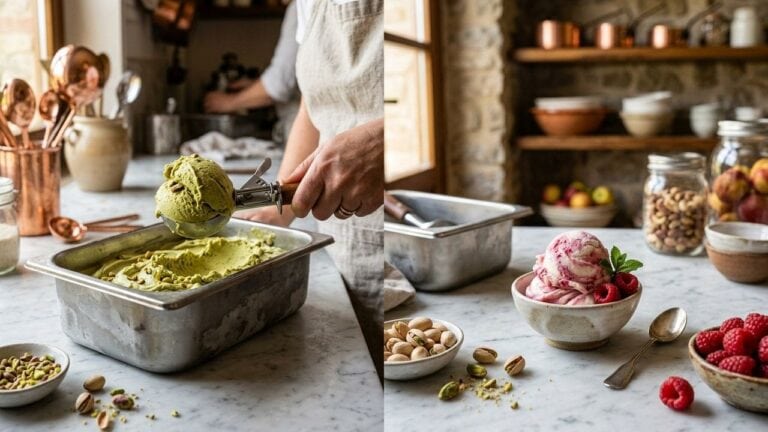
The second sign is in how it’s served. Gelato is generally not scooped into a round ball the way ice cream is. The seller typically uses a flat spatula to scoop it and arranges it in waves or neat stacks on top of a cone or cup. The sight of gelato piled high in waves is a hallmark of Italian-style presentation — while conventional ice cream is more often served as a ball with a round scoop.
These two signs are connected: because it’s served warmer, gelato is pliable enough to be worked with a spatula. Ice cream stored at -18°C is too hard for that, making round scooping more practical. So even before tasting, temperature and display style already give you a strong clue about gelato vs ice cream.
The Difference on the Spoon: Texture, Density, and Color
The third sign appears when the product hits your spoon. The key factor is overrun — the technical term for the amount of air injected during the freezing process. Industrial ice cream has an overrun of 50–100%, meaning its final volume can be 1.5 to 2 times that of the raw ingredients because of all that air. The result feels light and airy.
Artisan gelato has an overrun of only 20–30%. Less air means one spoonful of gelato literally contains more raw ingredients — making it feel more dense, heavy, and creamy. If a cup feels more “substantial” for the same size, that’s a strong sign you’re holding gelato.
The fourth sign is color. Artisan gelato tends to look more natural and less vivid, because it’s made from real ingredients with little air. Industrial ice cream often comes in brighter, more uniform colors. This sign is general — not an absolute rule — but combined with texture and temperature, it reinforces your conclusion.
The Difference on Your Palate: Why Gelato Flavor Is More Intense
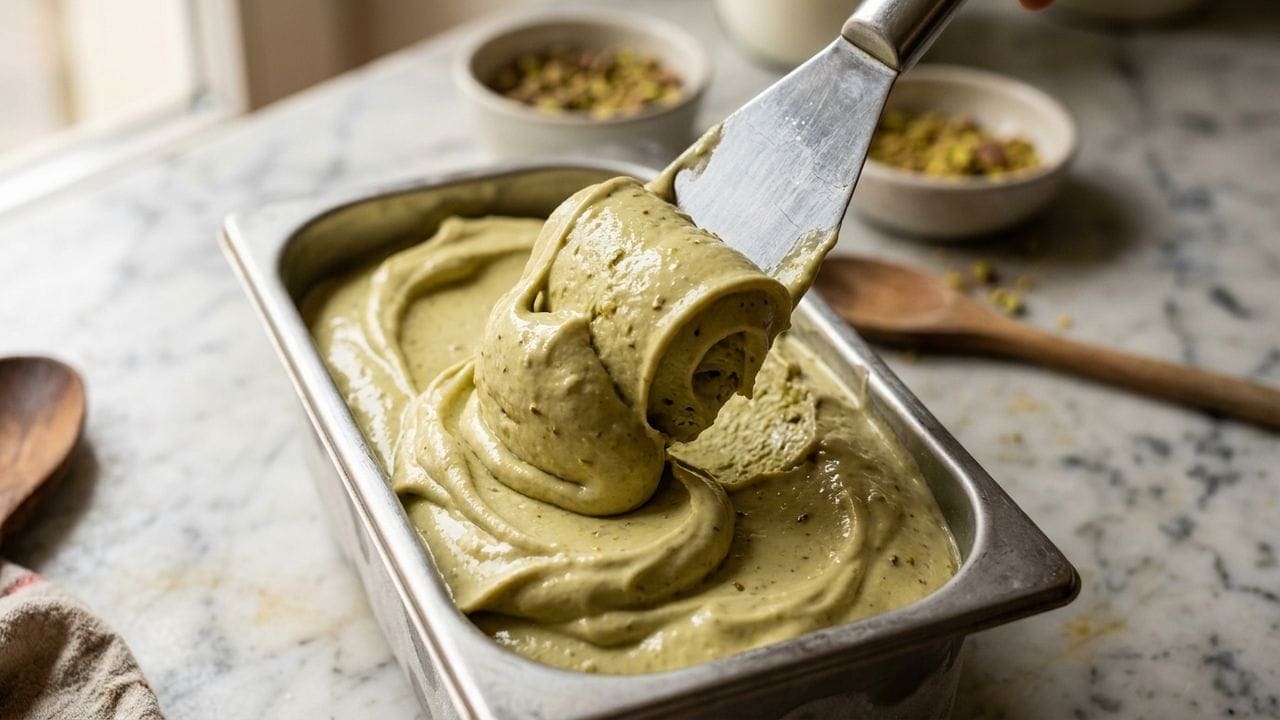
The fifth sign — and the most convincing — is felt on the first spoonful. Many people are surprised that gelato tastes more intense than ice cream, even though its fat content is actually lower. The explanation comes down to two things working together.
First, fat content. Gelato contains 6–8% milk fat, while conventional ice cream contains 14–16%. Fat coats the taste receptors on your tongue and slightly “blocks” flavor signals. With less fat, gelato’s flavors reach your palate more directly and more clearly.
Second, the serving temperature is warmer. At -11°C to -14°C, aroma molecules are more active than at -18°C. The closer to mouth temperature, the more aromas you can perceive simultaneously. That’s why a single spoonful of gelato often feels more “full” in flavor, even in the same portion size.
A Note from Mr. Jeff — Recipe & Method Creator
« The fastest way to recognize good gelato isn’t from its vivid color, but from the flavor that hits your palate directly. Bright colors are easy to make. Honest flavor — that comes from real ingredients and less fat getting in the way. »
Want to Understand the Difference Between Gelato and Ice Cream in Greater Depth?
Read our comprehensive guide exploring every aspect of the gelato vs ice cream difference — from nutritional content and production techniques to business opportunities in Indonesia.
Read the Gelato vs Ice Cream GuideThe Difference Behind the Scenes: Ingredients and Production Process
All the visible signs above actually trace back to one thing: how the product is made. Industrial ice cream generally uses high-fat cream and is produced through hot-process pasteurization of the mix at 80–85°C, then rapidly cooled before entering the freezing machine. This lengthy process requires large equipment and a spacious production facility.
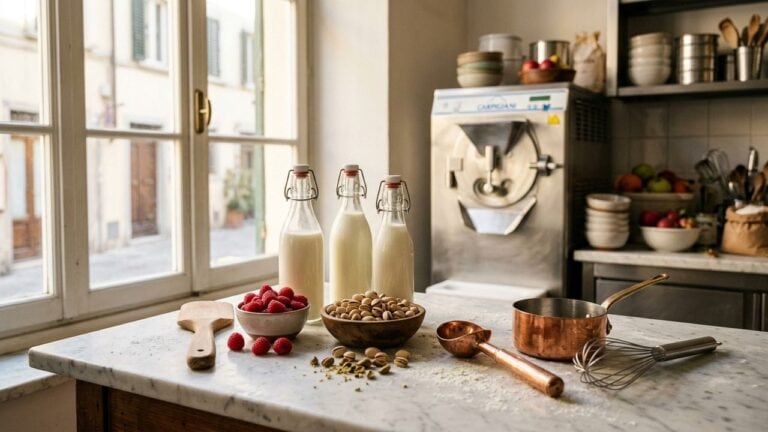
Artisan gelato uses more milk and less added cream. At La Gelato Academy, our instructor team teaches the cold process method with pre-formulated base powder — replacing traditional hot pasteurization with a cooler, more efficient approach for Indonesia’s tropical climate. This base powder formulation was itself developed by Mr. Jeff.
The core of La Gelato cold process is straightforward: start from cold UHT milk, mix quickly with base powder and flavoring syrup, then go straight into the batch freezer. Mixing time is under 5 minutes, followed by around 20 minutes per batch in the machine. No lengthy heating phase, no slow cooling — in line with the motto: Innovation without Pasteurization. No temperature gap — a more hygienic, more efficient product, through a lightning process.
This Difference Matters If You Want to Open a Gelato Business
If you’re simply an enthusiast, recognizing gelato vs ice cream is enough to help you choose the best product. But if you’re planning a business, this difference determines the startup capital you’ll need to prepare — and this is where the production method makes a huge gap.
Opening an ice cream business with the industrial hot process requires significant investment: a premium batch freezer machine, a pasteurizer (around Rp 400 juta), a shock freezer (around Rp 130 juta), plus a display case. The total estimate is Rp 400 juta to 1,5 miliar, plus three-phase electrical installation (~18 kW) and a 60–80 m² space.
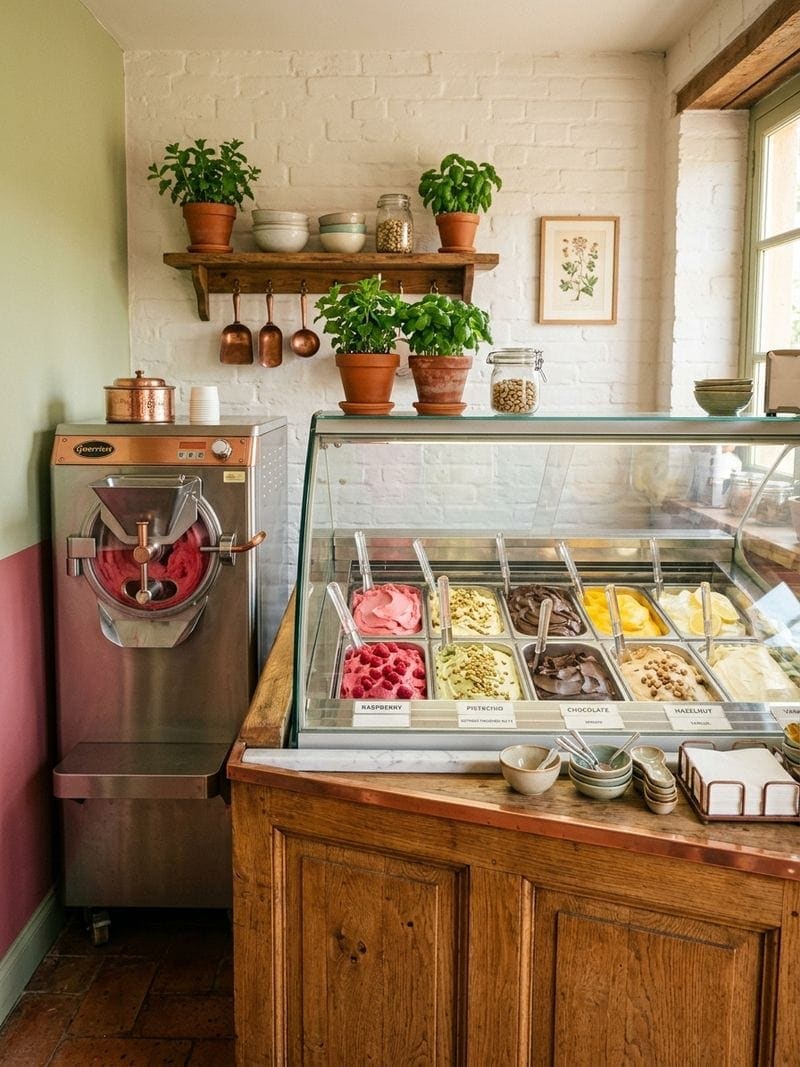
In contrast, La Gelato cold process gelato eliminates the need for a pasteurizer, shock freezer, and three-phase power. Three business packages are available to get started:
| Package | Price | Production Machine |
|---|---|---|
| BASIC PACKAGE | ≈ $1,400 (Rp 24,9 juta) | Wiratech 5L (local) |
| DELUXE PACKAGE | ≈ $3,350 (Rp 59,8 juta) | GEA BTY-5,4 (local premium) |
| PREMIUM PACKAGE | ≈ $4,200 (Rp 74,7 juta) | GEA BTY 8L (local premium) |
Every package includes the production machine, display case, La Gelato base powder, full accessories, and training. Standard residential PLN power of 3.2 kW is enough and a 20 m² space is sufficient for full operation. To understand the program and how to learn the method, you can view our gelato course details, designed for beginners through aspiring entrepreneurs.
Frequently Asked Questions About Gelato vs Ice Cream
What is the fastest sign to tell gelato and ice cream apart?
The fastest sign is at the display case: gelato is served warmer (-11°C to -14°C) so it looks soft and glossy, and is typically scooped with a spatula and arranged in waves — not shaped into a round ball like ice cream. Add a denser texture on the spoon and more intense flavor on the palate, and you’re almost certainly enjoying artisan gelato.
Why does gelato taste more intense even though its fat content is lower?
Precisely because its fat content is lower (6–8% vs 14–16% in ice cream). Fat coats the taste receptors on your tongue and slightly blocks flavor signals. With less fat, the flavor reaches your palate more directly. Add the warmer serving temperature, where aroma molecules are more active, and gelato tastes more “full” per spoonful.
Does a bright color always mean it’s ice cream and not gelato?
Not always — color is only a general indicator, not an absolute rule. Artisan gelato tends to have more natural colors because it’s made from real ingredients, while industrial ice cream often looks brighter. The color sign should always be combined with other signs like temperature, texture, and flavor for a more accurate conclusion.
What is the minimum startup cost for a gelato business in Indonesia?
With the La Gelato cold process method, the Basic Package starts from ≈ $1,400 (Rp 24,9 juta) — already including a local 5L batch freezer machine, display case, La Gelato base powder, operational accessories, and training. No pasteurizer, shock freezer, or three-phase electrical installation needed; standard residential PLN 3.2 kW is enough and a 20 m² space is sufficient for full operation. Contact our team in Yogyakarta for a consultation tailored to your situation.
Interested in Selling Your Own Artisan Gelato?
Contact the La Gelato Academy team for a free 15–30 minute consultation about your gelato business plan. We’ll help you choose the package best suited to your situation and budget — no pressure, no commitment.
Talk to Our TeamFree consultation — No commitment — Quick response
Conclusion: Spotting the Gelato vs Ice Cream Difference at a Glance
Gelato vs ice cream doesn’t need to be a guessing game. Five signs — temperature and display style at the case, spatula serving technique, dense texture on the spoon, more natural coloring, and more intense flavor on the palate — are enough to tell them apart even before you pay.
All those signs trace back to one thing: how the product is made. Artisan gelato relies on low fat content, low overrun, and a warmer serving temperature. The cold process method developed by Mr. Jeff brings Italian gelato quality to Indonesia’s tropical climate — Innovation without Pasteurization. No temperature gap — a more hygienic, more efficient product, through a lightning process.
Whether you want to become a more discerning enthusiast or plan a frozen dessert business, the steps are the same: recognize the difference, understand the reasons, then start from the right foundation.
About the Creator
Mr. Jeff
With years of experience in the Italian artisan gelato industry. Creator of all La Gelato recipes, methods, and production procedures — including the proprietary cold process method adapted for Indonesia’s tropical climate. Every formulation taught at La Gelato Academy has undergone extensive testing in the Yogyakarta laboratory before being integrated into the curriculum.
The philosophy he built into the curriculum is simple: knowledge shared honestly is the path to a prosperous business. Every component in La Gelato base powder, every step in the cold process, has been tested and proven — not simply adopted from textbook theory.
Mr. Jeff applies the same approach to the entire La Gelato ecosystem: the training academy (lagelatoacademy.com), the B2B raw materials factory, and the franchise program (la-gelato.com). Every part of this system has been real-world tested before being shared with course participants and franchise partners.