Choosing an ice cream machine is the most decisive decision when starting an Italian gelato business in Indonesia. The right machine will turn a premium recipe into a consistent product every day, while the wrong machine can lock you into the mass-market product category with thin margins.
Many aspiring gelato entrepreneurs in Indonesia start with a machine designed for industrial ice cream or soft serve, only to realize after six months that the equipment cannot produce the texture and density characteristic of Italian gelato. The result: an investment of tens of millions of rupiah that has to be redone, and time that cannot be recovered.
This article guides you in choosing an ice cream machine suited to your business goals — from home-based to professional business. The approach described here is drawn from recipes and methods developed by Mr. Jeff, creator of the La Gelato cold process system specifically adapted for Indonesia’s tropical climate and residential PLN electrical grid.
Key Points You Need to Know
- Three main categories of ice cream machines: batch freezer, soft serve, and combination machine — only the batch freezer is suitable for premium Italian gelato
- Machine capacity must be matched to daily volume: 5–10 liters/hour for home-based, 15–30 liters/hour for a café or outlet, 40+ liters/hour for a lab-scale business
- Initial investment in gelato machines in Indonesia ranges from Rp 25 million to Rp 250 million depending on scale and condition (new or quality used)
- Electricity consumption must be compatible with residential PLN at 3.2 kW if you are starting from home
- The cold process method changes machine selection criteria: without pasteurization, you need a batch freezer with precision temperature control, not an expensive integrated machine
What Is an Ice Cream Machine and Why Your Choice Determines Your Business
An ice cream machine is production equipment that freezes a liquid mixture (basic mix) while introducing air in a controlled manner to produce the characteristic texture of the final product. This process is called churning in Italian technical terminology: rapid cooling with mechanical agitation that determines the ice crystal size and air content in the final product.
The difference between the right machine and the wrong machine is not just about price or brand. Each machine category is designed for a different product philosophy. Soft serve machines are designed for high overrun (lots of air, light texture), while batch freezers for gelato are designed for low overrun (dense texture, high flavor intensity). Choosing the wrong machine means fighting your equipment’s basic physics every single day.
For an Italian gelato business, selection criteria must follow the characteristics of the final product you are targeting: dense texture, high density, flavor intensity that cannot be produced by a machine optimized for mass-market industrial products. That is why a generic ice cream machine commonly found on the Indonesian market is not automatically suited for premium gelato.
Three Main Categories of Ice Cream Machines for Gelato Business
Before comparing prices or specifications, you need to understand the three main categories of ice cream machines available on the Indonesian market. Each category serves a different production philosophy and they are not interchangeable.
The first category is the soft serve machine. This machine produces the product directly from the nozzle with a soft texture and high overrun (50–100% air). It is suited for quick-service operations such as mall booths, food trucks, or mid-range franchises with fast product turnover. The final product cannot be stored in a commercial freezer in ready-to-sell form — it must be produced on the spot and consumed within a few minutes.
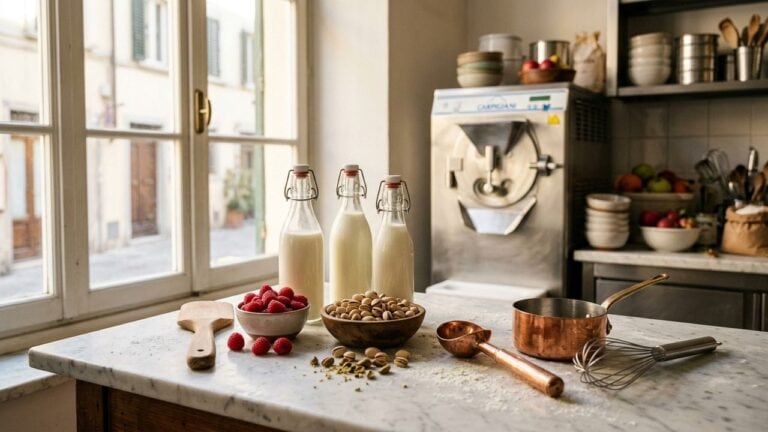
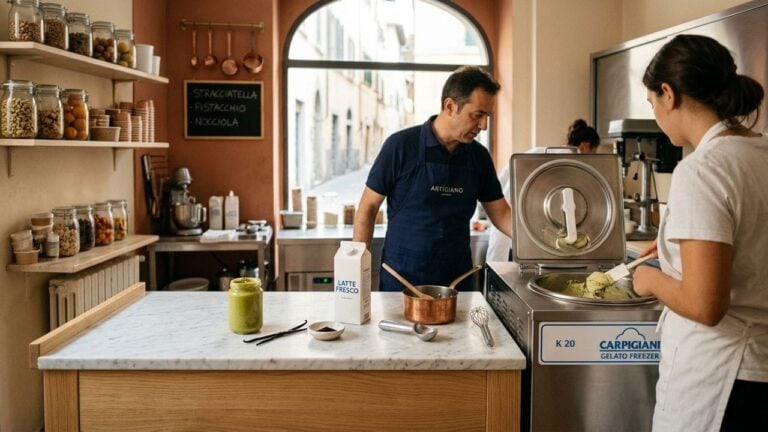
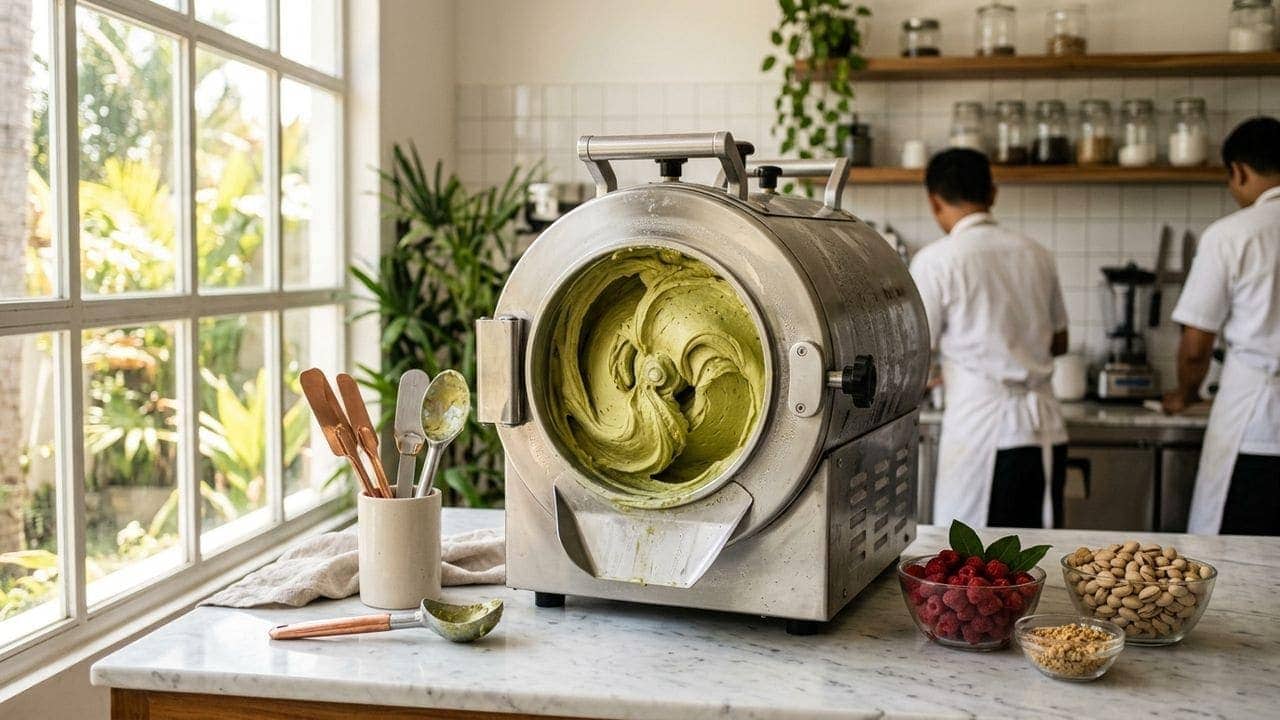
The second category is the batch freezer (also called mantecatore in Italian, or gelato batch machine). This is the category designed for artisanal gelato and ice cream. The machine processes one batch at a time (3–15 kg per cycle), producing a product with low overrun (20–35%), dense texture, and high flavor intensity. The product can be stored in a dedicated display case or hardening freezer for sale throughout the day.
The third category is the combination machine, which combines a pasteurizer and batch freezer in a single unit. This machine is suited for traditional operations using the hot process method. Its price is far higher (often 4–5× the price of a pure batch freezer) because it includes complex heating and cooling stages. For the cold process method, a combination machine is not needed.
Batch Freezer — Recommended Machine for Italian Gelato
For an Italian gelato business, La Gelato Academy’s recommendation is clear: choose a batch freezer with precision temperature control. This machine category is the heart of every professional gelato laboratory in Italy, and its adaptation to Indonesia is entirely feasible with a few key technical criteria.
First criterion: accurate extraction temperature control (target -8°C to -10°C depending on the recipe). A quality batch freezer allows you to stop the process at the precise temperature for each flavor, not just by timer. A precise temperature sensor is the differentiator between consistent results and unpredictable ones.
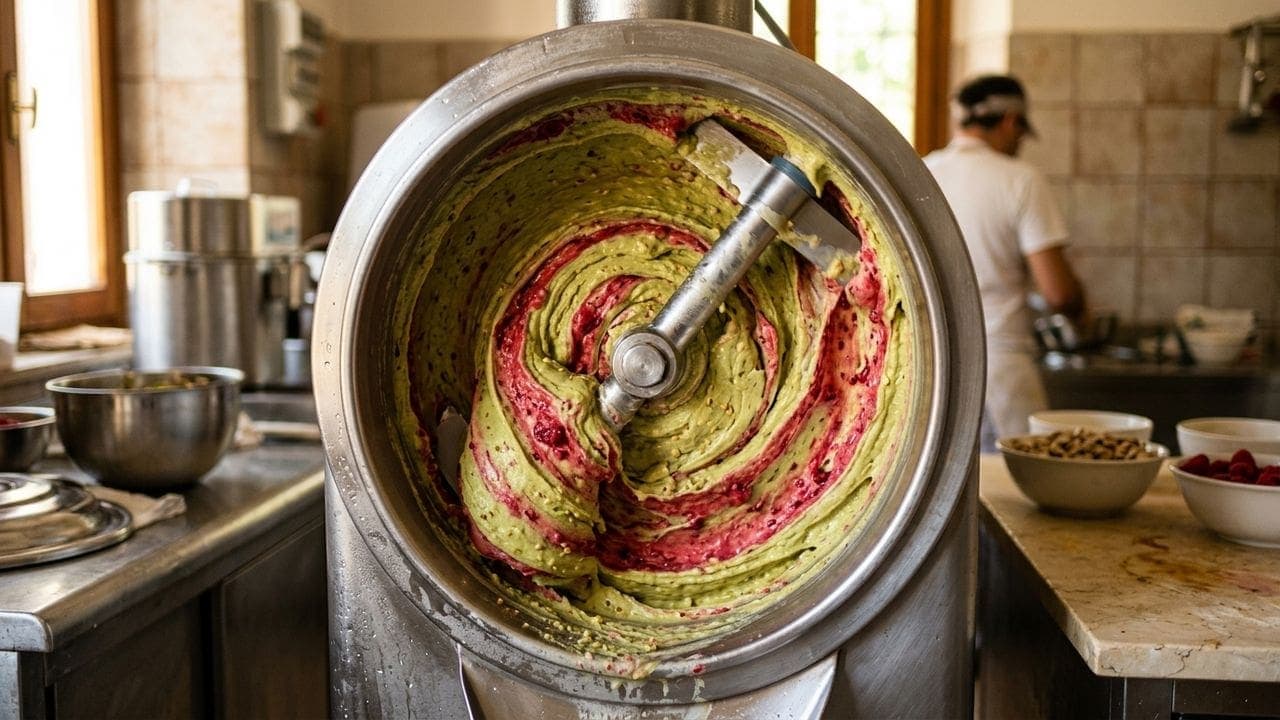
Second criterion: an agitator designed for low overrun. The mixing blades on a gelato batch freezer have a different geometry from a standard ice cream machine — slower, more powerful, with efficient scraping against the cooling cylinder wall. This detail determines the dense texture characteristic of gelato that cannot be replicated by a generic machine.
Third criterion: a compressor suited to the tropical climate. Many machines imported directly from Europe are designed for an ambient temperature of 18–22°C. In Indonesia, lab temperatures often reach 28–32°C without strong air conditioning. The machine you choose must have a compressor with sufficient cooling capacity, or you must invest in industrial air conditioning — a hidden cost that is often overlooked.
Note from Mr. Jeff — Recipe & Method Creator
« A good batch freezer is not the most expensive one, but the most stable one in your climate. I always recommend testing the machine at your actual location before buying — because what works in a European showroom may not work in Yogyakarta at two in the afternoon. »
Right Machine Capacity for Your Business Scale
One of the costliest mistakes made by beginner entrepreneurs in Indonesia is buying a machine that is too large for their actual business volume. An underutilized machine not only wastes investment but also produces inconsistent quality because the batch is too small for a machine designed for high volumes.
For home-based scale (beginner business package from home, sold via WhatsApp, delivery within 1–5 km): a batch freezer with a capacity of 3–7 liters per cycle is sufficient. Typical electricity consumption is 1.5–2.5 kW. You can run two to four batches per day, for a total production of 12–28 liters — enough for 60–140 standard 200ml cups.
For café or small outlet scale (1 fixed location, capacity 30–80 cups per day): choose a machine of 5–10 liters per cycle with a more powerful compressor. Electricity consumption 2.5–4 kW. The investment rises significantly, but durability and cycle speed also increase. Machines in this class can operate 8–10 hours a day without overheating.
For professional business or lab scale (multi-outlet, restaurant supply, or franchise): a capacity of 12–25 liters per cycle with two compressors (one for the freezing cylinder, one for the hardening cabinet) becomes standard. Electricity consumption 5–8 kW (requires 3-phase installation). Initial investment is much higher, but ROI is calculated in daily volume, not margin per cup.
The Right Machine Alone Isn’t Enough — You Need a Method
Investing Rp 50 million in a machine without the right recipes and method produces the same product as your competitors. Learn the La Gelato cold process method — Package 1 starting from Rp1.250.000 (regular price RP3JT), including lifetime access and 3 free raw material sachets delivered anywhere in Indonesia.
Ice Cream Machine Investment Estimate — From Home-Based to Professional Business
The most frequently asked question from aspiring gelato entrepreneurs in Indonesia is the realistic ice cream machine price for each business scale. Below are estimated price ranges applicable in the Indonesian market in 2026, covering both new and quality used machines with a verifiable track record.
| Business Scale | Capacity | New Machine Estimate | Quality Used Machine Estimate |
|---|---|---|---|
| Home-based | 3–7 liters/cycle | Rp 25–60 million | Rp 12–28 million |
| Café / Small outlet | 5–10 liters/cycle | Rp 60–120 million | Rp 28–55 million |
| Professional Business / Lab | 12–25 liters/cycle | Rp 120–250 million | Rp 55–110 million |
| Multi-outlet / Franchise | 25+ liters/cycle, 2 compressors | Rp 250 million and above | Rp 110–180 million |
The estimates above cover only the main unit. You need to add peripheral costs: a display case freezer (Rp 15–40 million depending on size), a blast freezer or hardening cabinet (Rp 20–50 million), and support workstation equipment (precision scales, industrial blender, GN containers). Total initial setup is typically 1.5× to 1.8× the price of the main machine.
An important consideration about used machines: the used gelato machine market in Indonesia is healthy for beginners looking to reduce initial investment risk, but requires thorough technical inspection. Check the compressor condition, cooling cylinder integrity, service history, and availability of spare parts. A quality used machine can save 50–60% of initial investment with 5–8 years of remaining useful life.
Electricity Consumption and Indonesian Tropical Climate Adaptation
A factor that is often underestimated when choosing an ice cream machine in Indonesia is compatibility with the PLN electrical grid and the tropical climate. A machine that performs well in a showroom may not be suited to your home electrical installation or Yogyakarta’s humid climate.
Indonesia’s residential PLN standard is generally 2,200 VA (approximately 1,760 W usable) or 3,500 VA (3.2 kW usable). If you plan to start from home, your machine must operate comfortably within the 3.2 kW limit including other appliances (refrigerator, air conditioning, lab lights). A machine requiring 4 kW or more will trip the circuit breaker and force you to upgrade your power capacity — causing a significant increase in your monthly PLN electricity bill.
For café or professional scale, consider 3-phase installation which provides capacity of 6,600 VA or 10,600 VA. Initial installation is more expensive (Rp 5–15 million depending on PLN location), but it enables professional machine operation without the risk of network overheating. Consult a certified electrician before purchasing your machine.
Tropical climate adaptation is the second crucial dimension. Lab ambient temperature in Indonesia often reaches 30°C without strong air conditioning, conditions that reduce compressor cooling efficiency by 15–25%. The machine you choose must have documented cooling capacity at an ambient temperature of 30°C — not just at the 22°C European standard. Ask clearly for the technical datasheet during purchase negotiations.
Cold Process — Why the Pasteurization-Free Method Changes Your Machine Choice
The cold process method developed by Mr. Jeff for La Gelato has significant consequences for your machine choice. Unlike the traditional hot process method that requires an integrated pasteurizer (a machine that heats the mixture to 85°C, holds, then rapidly cools), cold process uses commercially sterile UHT milk combined with La Gelato pre-formulated base powder (GP-BASE, GS-BASE, XP-BASE, SOFTIZ) — you only mix to cold and load directly into the batch freezer.
The cold process motto that forms the foundation of the La Gelato method:
« Innovation without pasteurization. No temperature gap — a more hygienic, more efficient product, through a lightning process. »
Consequences for machine choice: you no longer need an expensive combination machine that integrates pasteurizer and batch freezer. Your initial setup becomes 25–30 times cheaper compared to a traditional hot process setup. The machine you need is simply a pure batch freezer with good temperature control — an investment of Rp 25–60 million for home scale, instead of Rp 600 million to Rp 1.2 billion for a complete hot process setup.
Second consequence: production time drops dramatically. Without the heating and cooling stage in the pasteurizer, one gelato production cycle with cold process runs in 12–18 minutes from mixing to ready product. Traditional hot process requires 4–6 hours because you must heat, hold, cool, mature, then freeze. This time efficiency is what makes cold process viable for small and medium operations in Indonesia.
Third consequence: hygiene and food safety become simpler to manage. Without the routine pasteurization cycle that requires thermal validation, you reduce the risk of cross-contamination and the need for complex HACCP documentation. Regulatory compliance remains full, but daily management is far lighter.
Common Mistakes When Choosing Your First Ice Cream Machine
Based on the experience of witnessing hundreds of beginner gelato entrepreneurs in Indonesia, La Gelato Academy’s instructor team has identified five recurring mistakes. Recognizing these patterns before you sign an invoice can save an investment of tens of millions of rupiah.
First mistake: buying based on the cheapest price without factoring in total cost of ownership. A Rp 15 million machine that requires Rp 3 million in maintenance every 3 months and difficult-to-find spare parts is actually more expensive over 2 years than a Rp 35 million machine with local technical support.
Second mistake: ignoring spare parts and technician availability. Machines imported directly from small manufacturers in Eastern Europe or China may have an attractive initial price, but when the compressor breaks down after 18 months, you face a 3–8 week waiting time for imported spare parts — a period during which your business comes to a complete halt.
Third mistake: choosing a soft serve machine to sell gelato. Soft serve is designed for high-overrun products that are consumed immediately. If you try to sell a soft serve product as premium gelato, your customers will feel the difference in texture and will not come back. The market position you are targeting determines the machine category, not the other way around.
Fourth mistake: buying too much capacity at the start. A 25-liter-per-cycle machine for a business with an actual production of 5 liters per day is a waste of electricity and space. It is better to start with capacity that fits your initial plan, then upgrade when demand genuinely grows.
Fifth mistake: ignoring compatibility with the recipe and method you will use. A technically good machine that does not suit your cold process recipes will produce inconsistent texture. That is why La Gelato Academy integrates technique training with equipment understanding in one unified curriculum.
Note from Mr. Jeff — Recipe & Method Creator
« The technique you learn with one machine can be transferred to all other gelato machine brands. What matters is mastering the principles — not becoming dependent on a single brand. This is also the principle embedded throughout the La Gelato curriculum. »
After Buying the Machine — What You Need to Learn to Succeed
The right machine is only one component of a successful ecosystem. Beginner gelato entrepreneurs in Indonesia who succeed in the first 2 years generally master four additional dimensions after the equipment is installed.
First dimension: recipes and formulation. Each flavor requires a different ratio of sugar, fat, milk solids, and stabilizers. The same machine can produce perfect texture for pistachio and poor texture for strawberry if the formulation is not adjusted. This is what La Gelato Academy course participants learn through the recipe engineering module.
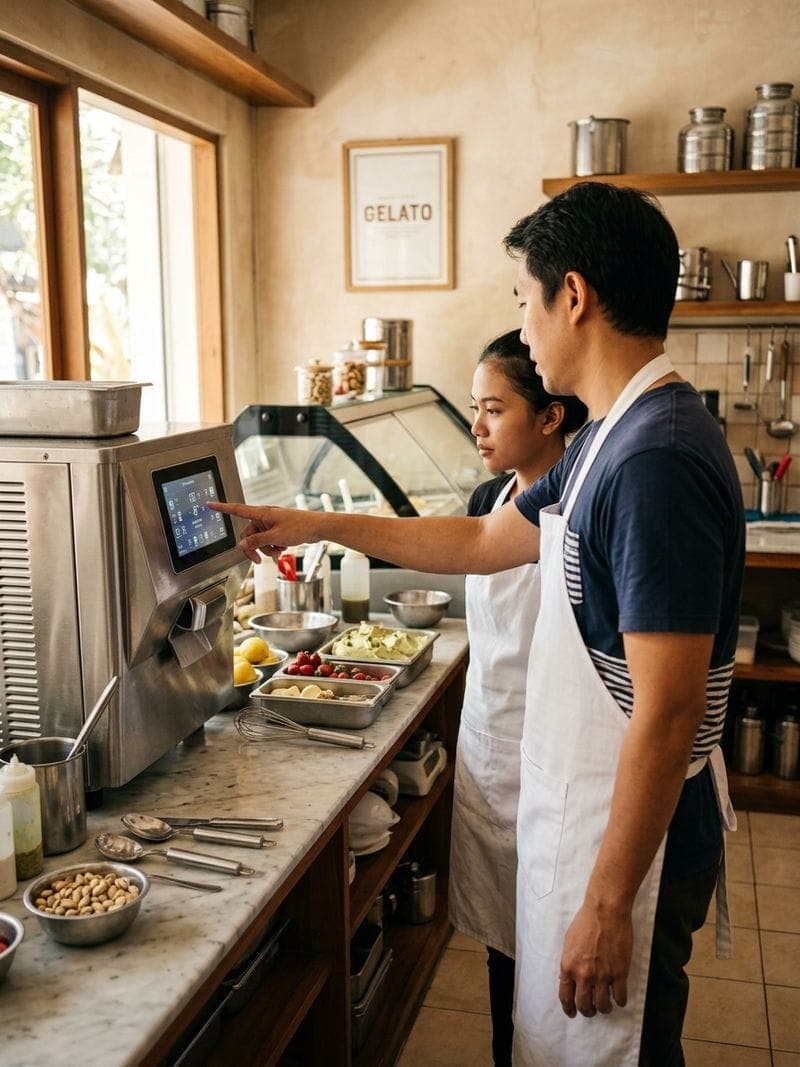
Second dimension: machine operating parameters. Extraction temperature, agitator speed, cycle duration, and hardening timing must be adjusted for each flavor and lab condition. The hands-on workshop in Yogyakarta covers this training directly with the same machine you will use in your business. For a deeper understanding of the fundamentals of Italian gelato versus industrial ice cream, see our ice cream course guide for Indonesia.
Third dimension: HACCP hygiene and compliance. Indonesia enforces strict food safety standards, especially for dairy-containing products. Daily machine cleaning procedures, weekly sanitation, and temperature documentation must be standardized from day one. This is not optional — BPOM and the health department can shut down non-compliant operations.
Fourth dimension: business strategy and positioning. The best machine with the best recipes means nothing if product positioning is wrong. Are you targeting a premium café, mall retail, or direct-to-consumer via WhatsApp? Each positioning requires a different cost structure, pricing, and branding. The business strategy module in the La Gelato Academy course helps you map this out before major investment is made.
Frequently Asked Questions About Ice Cream Machines
What is the minimum budget to buy an ice cream machine for gelato?
For home-based scale with the cold process method, a realistic budget starts at Rp 25 million for a new batch freezer with a capacity of 3–5 liters per cycle. Quality used machines can be found from Rp 12–18 million with thorough technical inspection. Add 1.5× for the display case and essential peripherals. Total initial home-based setup ranges from Rp 40–70 million.
What is the difference between a soft serve machine and a batch freezer?
A soft serve machine produces the product directly from the nozzle with high overrun (50–100% air) and soft texture, suited for immediate consumption. A batch freezer processes one batch at a time with low overrun (20–35%), producing a dense product with high flavor intensity that can be stored in a display case. For Italian gelato, the batch freezer is the right choice.
Do I need a separate pasteurizer for gelato production?
No, if you use the cold process method. La Gelato uses commercially sterile UHT milk plus pre-formulated base powder, which can be combined directly to cold without any additional pasteurization stage. Your initial setup becomes 25–30 times cheaper compared to a traditional hot process setup that requires a pasteurizer costing around Rp 240–480 million (with total industrial setup typically reaching Rp 400 million to Rp 1.5 billion).
How much electricity does a gelato machine consume for home-based operation?
A typical home-based batch freezer consumes 1.5–2.5 kW during operation. With a residential PLN grid of 3,500 VA (3.2 kW usable), you can run the machine while still using a refrigerator and light air conditioning. Make sure to calculate total daily load before buying a larger machine — upgrading to 5,500 VA or 3-phase requires an additional installation cost of Rp 5–15 million.
Used or new ice cream machine — which is better for beginners?
For beginners with a limited budget, a quality used machine is a rational choice if you can verify: (1) complete service history, (2) compressor and cooling cylinder condition, (3) local spare parts availability, and (4) a minimum 6-month warranty from the seller. A used machine can save 50–60% of initial investment with 5–8 years of remaining useful life. Avoid machines without complete documentation, regardless of price.
Can the techniques learned at La Gelato Academy course be applied to all machine brands?
Yes, entirely. La Gelato Academy’s philosophy is to teach universal principles — temperature control, agitation parameters, recipe formulation — that can be transferred to all batch freezer brands. You are not locked into any particular brand. During the hands-on workshop in Yogyakarta, we use a Maestro machine for demonstration, but participants can apply the same techniques on other machine brands in their own labs.
Still Unsure Which Machine to Choose?
Before investing tens of millions of rupiah, contact the La Gelato Academy team for a free 15–30 minute discussion about machine specifications suited to your business plan. We help you choose the right category and capacity — no pressure, no commitment.
Free consultation — No commitment — Fast WhatsApp response
Conclusion: The Right Machine for Your Gelato Business
Choosing an ice cream machine for an Italian gelato business in Indonesia is a decision with three interconnected dimensions: machine category (batch freezer for premium gelato), capacity suited to business scale (from 3 liters home-based to 25+ liters professional), and compatibility with the PLN electrical grid and Indonesia’s tropical climate.
The cold process method developed by Mr. Jeff fundamentally changes the economics of machine selection: without pasteurization, you only need a pure batch freezer with an investment 25–30 times lower than a traditional hot process setup. « Innovation without pasteurization. No temperature gap — a more hygienic, more efficient product, through a lightning process. »
The right machine is the foundation, but not the entirety of the business. Recipes, machine operating parameters, HACCP hygiene, and positioning strategy are the components that determine whether your machine investment generates ROI in 6–12 months or becomes a prolonged burden. This is what La Gelato Academy participants learn through an integrated curriculum combining technique and strategy.
About the Creator
Mr. Jeff
Creator of all recipes, methods, and production procedures at La Gelato — including the proprietary cold process method adapted for Indonesia’s tropical climate. A graduate of an Italian glacier diploma, he developed and tested recipe adaptations for years in La Gelato’s laboratory in Yogyakarta before integrating them into the course curriculum.
The philosophy he has embedded in the curriculum is simple: knowledge shared honestly is the path to a blessed business. Every recipe, every technical procedure, and every equipment recommendation taught at La Gelato Academy has passed dogfooding — tested for months in our own laboratory before reaching course participants.
Mr. Jeff applies the same approach to the entire La Gelato ecosystem: the training academy (lagelatoacademy.com), the B2B raw materials factory, and the franchise program (la-gelato.com). Every component of the system on offer has been genuinely proven before being shared with the Indonesian gelato entrepreneur community.