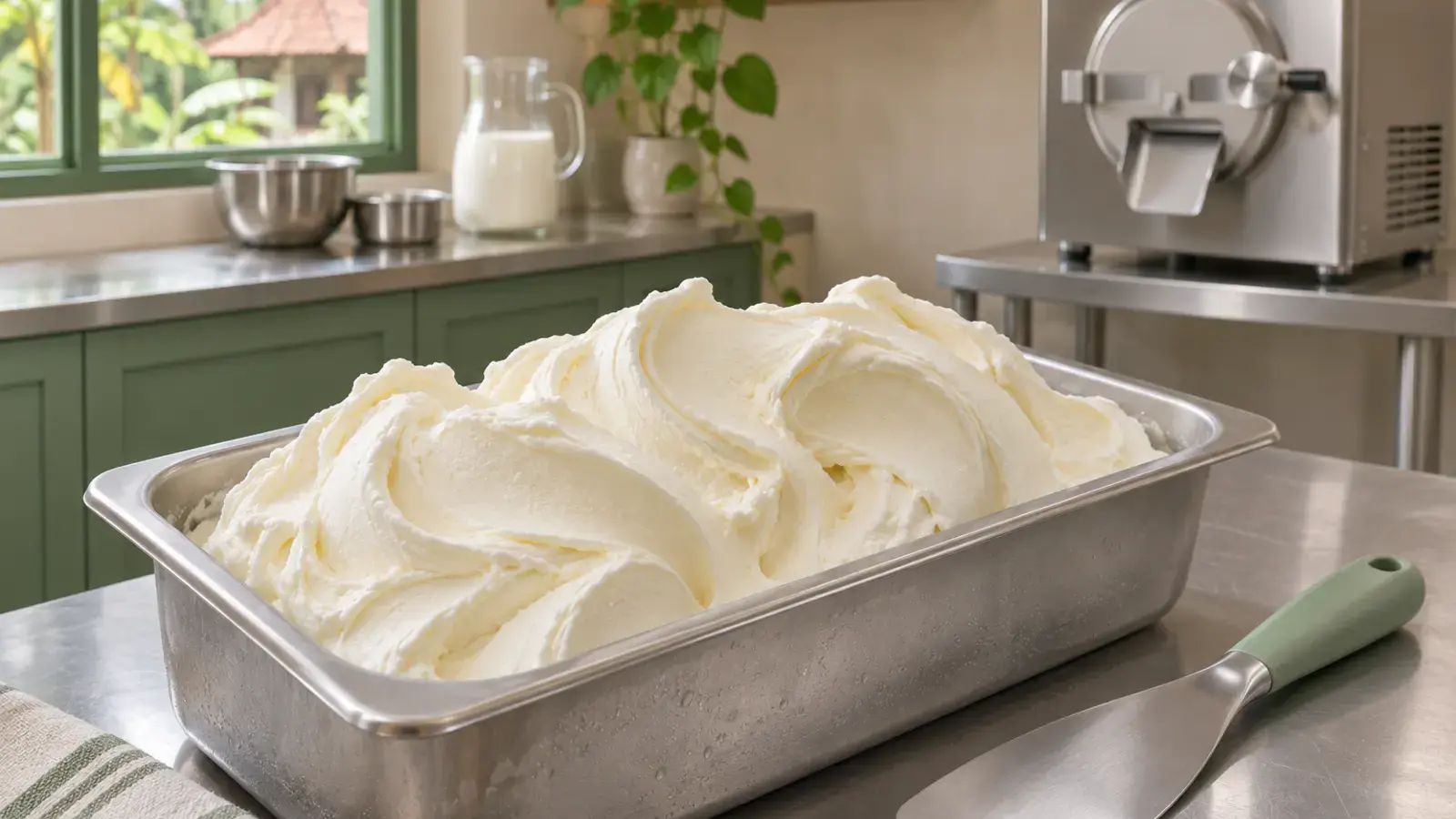
An egg-free gelato recipe can use milk, cream, sugar, and supporting ingredients suited to the process, then be frozen while churning in a batch freezer. For your first trial, choose a plain milk flavor so you can assess flavor, smoothness, and consistency without flavoring pastes or toppings getting in the way.
This guide uses a sample formula as a starting point for testing, not a standard recipe that works under every condition. Its suitability depends on your ingredient and machine specifications. Before weighing anything, confirm that the base and all other ingredients can be used without an additional heating step.
- Egg-free milk gelato still contains dairy and is not automatically vegan or allergen-free.
- Your test formula must use a base with a dosage and processing instructions that match the recipe.
- Cold processing does not replace hygiene controls, appropriate ingredient selection, or cold-chain management.
- Evaluate the gelato after hardening and under consistent serving conditions, not just as it comes out of the machine.
Egg-free gelato recipe: what to aim for
The goal of this exercise is milk gelato with a clean flavor, a smooth texture, and scoopability that suits your serving conditions. Do not rely on a white color or glossy appearance as your only signs of success. Pay attention to mouthfeel, sweetness, and changes in texture after storage.
In a custard base, egg yolks contribute fat, solids, and emulsifying components. An egg-free formula needs to be built from the start without relying on those functions. Simply removing eggs from a custard recipe will not necessarily produce a balanced mix.
Milk and cream remain the main components of this recipe. Egg-free therefore does not mean dairy-free, vegan, or automatically safer. Check the base ingredients and the potential for cross-contact on equipment and in the production area before preparing product information for customers. For claims such as “egg-free” or allergen information on labels and menus, confirm the requirements with the relevant food safety authority.
Is gelato ice cream, and how is it different from custard?
In everyday usage, gelato belongs to the ice cream family. Generally, gelato has lower overrun, meaning less air is incorporated during freezing, and is served at a warmer temperature than many industrially produced ice creams. This gives it a denser texture. However, the name gelato alone does not tell you everything about its ingredients or production process. Some gelato recipes contain eggs, and others do not. This recipe uses an egg-free milk base, not a custard base.
Egg-based custard requires processing appropriate for those ingredients. Cold processing, on the other hand, depends on ingredients specifically designed or confirmed to be suitable for cold mixing. This distinction is not a reason to skip food safety procedures.
Freezing a mix in a container and stirring it occasionally can be a home experiment, but it is not the same as freezing with controlled churning. For this guide, use a batch freezer so you can learn to evaluate the recipe alongside the machine process you will use.
Ingredients and equipment: check cold-process compatibility
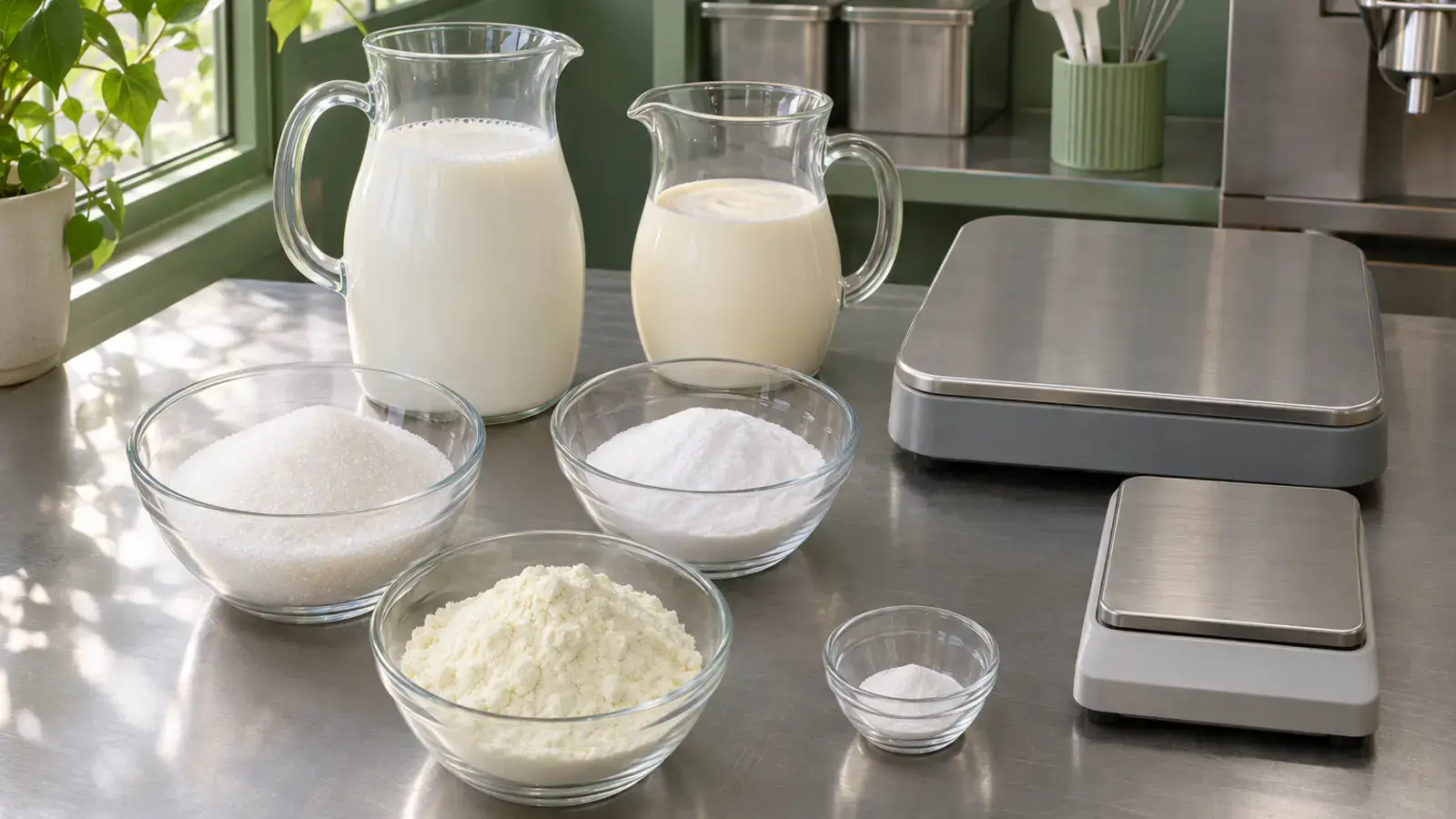
Select egg-free gelato ingredients based on their labels and technical data sheets, not just their trade names. Use heat-treated whole milk and unsweetened dairy cream, either pasteurized or UHT, in good condition and stored according to the manufacturer’s instructions. Record the brand and composition specifications so you can repeat the trial.
- Granulated sugar and powdered dextrose: weigh them separately; do not substitute syrup for dextrose without recalculating the formula.
- Skim milk powder: choose a product suitable for this use and check its handling instructions.
- Egg-free neutral base: choose a stabilizer and emulsifier blend for milk gelato that is explicitly suitable for cold processing.
- Ingredient documentation: confirm that the supplier allows use without additional heating, including any hydration and storage requirements.
Prepare a digital scale, a precision scale for the base, containers with lids, a mixer or immersion blender, a food thermometer, a spatula, a batch freezer, and equipment for hardening and frozen storage. Follow equipment cleaning and sanitizing procedures. The amount of mix must fall within the machine’s minimum and maximum batch capacity.
If ingredient specifications are unclear, do not guess. Ask the supplier for confirmation or choose ingredients with complete instructions before making cold-process egg-free gelato.
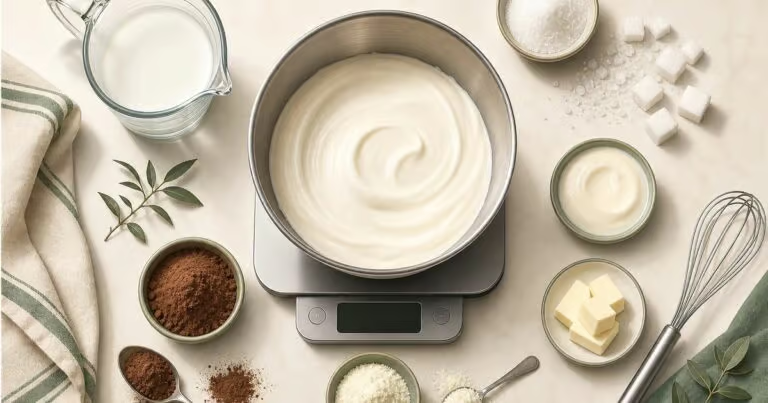
Basic egg-free milk gelato formula and weighing method
Here is a sample formula for 1,000 g of mix before freezing. These quantities are for testing, not an industry standard or a guarantee of results. The formula applies only if your chosen neutral base specifies a dosage of 5 g per 1,000 g of total mix and is compatible with this ingredient composition.
| Ingredient | Weight | Selection notes |
|---|---|---|
| Pasteurized or UHT whole milk | 695 g | No added sweeteners or flavorings |
| Pasteurized or UHT cream | 100 g | Unsweetened dairy cream, not a ready-to-whip topping |
| Granulated sugar | 140 g | Weigh dry |
| Powdered dextrose | 40 g | Record product specifications for repeat batches |
| Skim milk powder | 20 g | Suitable for use without additional heating |
| Egg-free cold-process neutral base | 5 g | Only for a product specifying this dosage |
| Total mix | 1,000 g | Does not account for residue left on equipment |
A concentrated base is not the same as a complete premix that already contains substantial amounts of sugar and milk solids. If your base type or dosage differs, do not copy the table and simply add more base. Use the supplier’s accompanying formula as a starting point for adjustments, or seek formulation support.
Tare the scale after placing each empty container on it. Weigh ingredients separately before mixing so errors are easier to spot. Do not measure the base with household spoons. To understand why ingredient proportions matter, review gelato ingredients and their functions, and avoid changing several ingredients at once in your first trial.
Production steps: from mixing to the batch freezer
Prepare a worksheet before opening any ingredients. Record the batch ID, ingredients used, actual weights, and processing conditions. Follow the base and machine instructions wherever they provide a more specific sequence than the general steps below.
- Check that everything is ready. Confirm that ingredients are suitable for cold processing, equipment is clean and sanitized, and cooling equipment is ready to use. Do not begin if you cannot maintain the cold chain.
- Combine the dry ingredients. If the base instructions allow it, mix the base with the granulated sugar, dextrose, and milk powder until evenly distributed. This helps reduce clumping when the ingredients are added to the liquid.
- Prepare the liquids. Pour the milk and cream into a container with enough capacity. Gradually add the dry mixture while stirring until dispersed, including at the bottom and along the sides of the container.
- Blend until uniform. Use a mixer as directed by the ingredient instructions. If using an immersion blender, keep the head submerged to avoid incorporating excess air. Do not proceed while unresolved lumps remain.
- Allow hydration as directed. Cover the container and maintain the required cold conditions. Follow the ingredient technical data sheet and food safety procedures for holding time and temperature, rather than relying on a universal number.
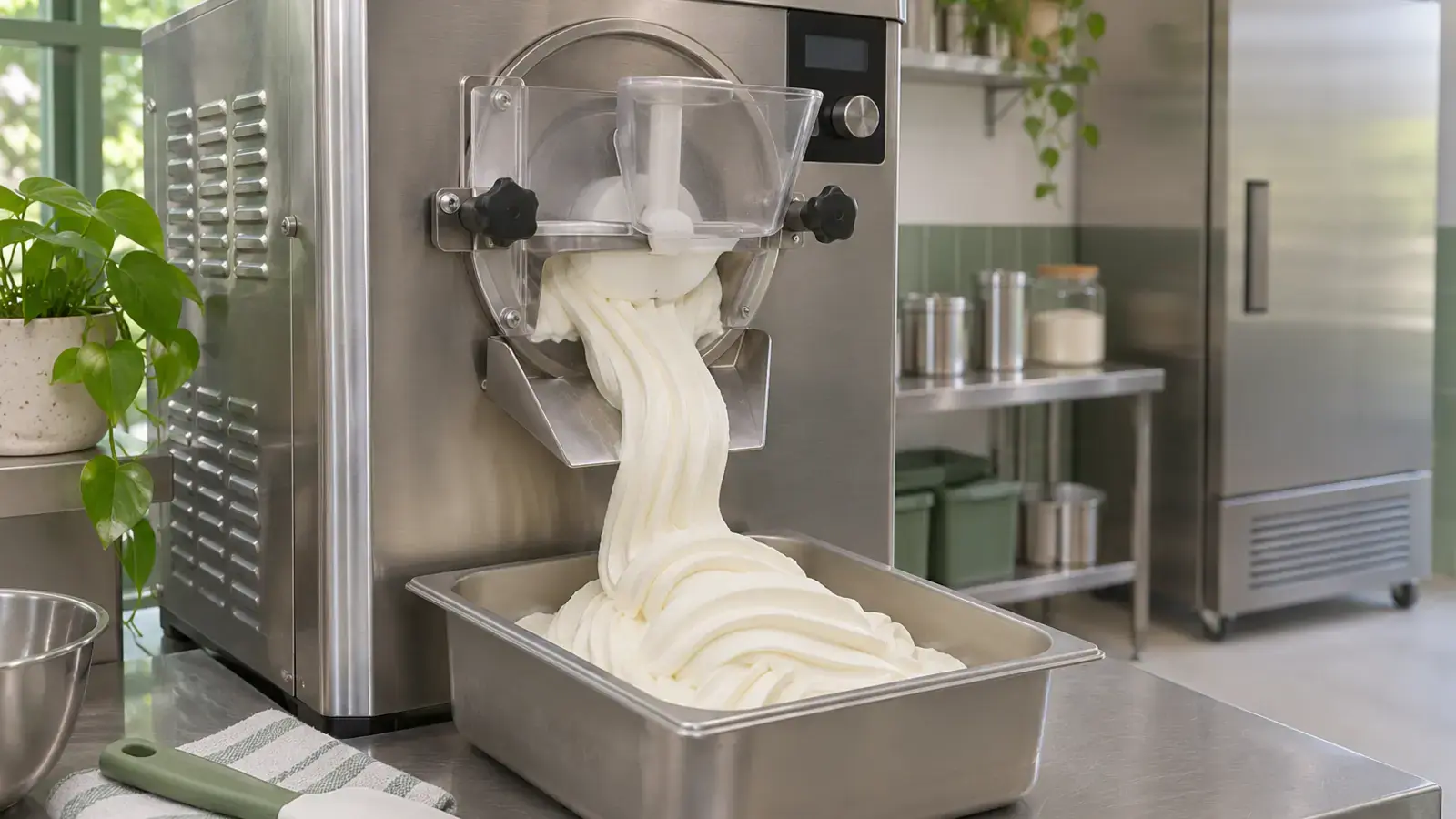
- Process in the batch freezer. Set up the machine according to its manual, load the mix within its capacity limits, and run the appropriate cycle. Record the actual processing time and conditions at extraction.
- Transfer for hardening. Use prepared food-safe containers, avoid leaving the product on the workbench, and follow the further-freezing procedure appropriate for your equipment.
Do not treat cold mixing as pasteurization. Even pasteurized or UHT milk and cream can become contaminated after opening and during handling. To assess whether equipment fits your production plans, use this guide to choosing a gelato machine for beginners.
Batch evaluation: flavor, texture, and sandiness
Evaluate samples at extraction, then after hardening under the same serving conditions for every batch. A product that feels soft straight from the machine may not have the same texture after storage. Use a clean spoon each time you take a sample.
Start with milk flavor, sweetness, and the lingering sensation in your mouth. Then check the texture. Notes such as “too sticky,” “hard to scoop,” or “feels grainy” are more useful than simply writing “doesn’t taste good.”
- Visible particles before freezing: check whether the dry ingredients have dissolved, whether the base has clumped, and whether the hydration process was followed correctly.
- A texture like ice flakes: check the formula’s balance of solids and water, the freezing and transfer processes, and the history of temperature changes during storage.
- A sandy mouthfeel after storage: consider crystallization issues, including lactose crystallization, but do not diagnose the cause from appearance alone.
Do not respond to every problem by adding stabilizer or milk powder. Compare your batch notes with the ingredient instructions, then change one variable in the next trial. This discussion of ice crystals and sandy gelato texture can help you identify what to check without replacing hands-on evaluation of your own product.
Where should gelato be stored after production?
Learning how to store gelato starts with understanding what each piece of equipment does. Hardening, frozen storage, and the showcase are not three names for the same stage. Having a freezer alone does not mean you are ready for production.
Hardening after extraction
Hardening is the further-freezing stage that firms up the product after it leaves the batch freezer. Use equipment that can handle this stage at your production volume. Arrange containers and airflow according to the equipment instructions; do not assume a showcase can replace hardening equipment.
Frozen storage for stock
Store stock in covered food-safe containers labeled with the batch ID and production date. Monitor the actual temperature, not just the equipment’s setpoint. Avoid repeatedly opening containers or moving the product back and forth between warm areas and the freezer.
A showcase for service
A showcase keeps the product under suitable serving conditions. Evaluate scoopability based on the formula and equipment performance. Set operating temperatures and storage time limits through validated procedures; this article does not prescribe a universal shelf life. Products exposed to temperature deviations need to be evaluated according to food safety procedures, not simply refrozen.
Testing egg-free gelato for cafes with production records
Before adding egg-free gelato to your cafe menu, repeat the trial with documented ingredients and conditions. The goal is not just to make one good container of gelato, but to find out whether another operator can reproduce the result.
Keep records of ingredient weights, lot numbers, hydration instructions, machine settings, extraction time, hardening conditions, and evaluations after storage. Also record the weight of product you can actually sell and the residue left on equipment. These actual measurements are more useful for portion planning than estimating yield from container volume.
In day-to-day production, weighing accurately, reading base specifications, maintaining hygiene, and evaluating batches are just as important as operating the machine. If you are still planning your learning path, a guide to gelato courses for beginners can help you decide on the next step. Bring your trial notes when discussing your formulation and cold-process training needs with La Gelato Academy.
Want to understand formulation, cold-process ingredient selection, and batch evaluation for your cafe plans? Explore La Gelato Academy's course and discuss your training needs based on your equipment and trial records.
Explore the La Gelato Academy courseFrequently asked questions
Does egg-free gelato mean it is vegan?
No. This recipe uses milk and cream, so it is not vegan. Also check the base ingredients and how equipment is handled; egg-free does not guarantee that a product is allergen-free or free from cross-contact.
Can I make this recipe without a batch freezer?
This guide is designed for freezing while churning in a batch freezer. A static freezer method does not provide the same process, so you should not expect equivalent texture or results.
Are all gelato bases suitable for cold processing?
No. Some bases require heating or specific hydration procedures. Use only products whose instructions explicitly allow cold processing, and make sure the dosage matches the formula.
Why does egg-free gelato feel sandy?
Causes can vary, from ingredients that have not fully dispersed to crystallization during storage. Record when the sensation appears and distinguish it from ice flakes before adjusting the recipe. Do not automatically add milk powder or stabilizer.
How long can gelato made with this recipe be stored?
Shelf life cannot be determined from this ingredient list alone. Storage limits need to be established through food safety procedures and product evaluation that account for your process, packaging, and cold chain.