The best gelato in Indonesia is not a single name — it is a category of experience you can recognize once you understand what makes a glaceria worth calling artisanal. Between the fast-growing gelato scenes in Yogyakarta, Bali, and Jakarta, many options are open — some authentic, some merely using the word « gelato » as a premium label with no technical substance behind it.
This guide is written to help you tell the difference. You will find the objective criteria used by Italian gelatieri to assess quality, how to recognize an artisanal glaceria within the first few minutes of a visit, and an overview of the cities with the most vibrant gelato scenes in Indonesia. The goal is simple: every time you buy a scoop, you know what is behind the price and the flavor.
This guide is based on the method developed by Mr. Jeff, who created all the recipes and production procedures at La Gelato — including the cold process method adapted for Indonesia’s tropical climate. We will explain each criterion technically, honestly, and without imposed hierarchy: what matters is not « who is number one », but « what makes a gelato worth your time ».
Key Points to Keep in Mind
- Authentic gelato uses 4–9% milk fat and 25–35% overrun — not American ice cream with an Italian label.
- Ideal serving temperature is between -12°C and -14°C, not -18°C like a home freezer.
- A truly artisanal glaceria prepares gelato daily in small batches and uses fresh local ingredients — not industrial premix.
- Yogyakarta, Bali, and Jakarta have the most mature gelato scenes, but each city has its own identity and strengths.
- The best experience starts with understanding what you are tasting — not simply looking for an Italian sign.
What « Best Gelato » Means — Between Personal Taste and Objective Standards
Before exploring cities across Indonesia, one question must be answered first: what does it mean for a gelato to be called « the best »? Many people assume this is purely a matter of personal taste — you like pistachio, I like chocolate, so there is no single answer. That is half true. Taste is subjective, but production quality is not. A gelato can be evaluated technically, just like specialty coffee, wine, or artisanal chocolate.
In Italy, associations of gelatieri such as the Gelato Festival and international competitions use relatively consistent criteria: the quality of raw materials, the precision of the production technique, serving temperature, texture density, flavor clarity, and recipe creativity. A casual enthusiast does not need to become a professional judge — but once you understand the criteria, you will be surprised how quickly your palate can tell serious gelato from something merely sold under an Italian name.
In other words, « best gelato in Indonesia » does not have to mean one glaceria that beats all others. More accurately, it means the glacerie that consistently meet artisanal standards — and among those, you choose the one that best matches your taste. This guide gives you the framework to make that assessment yourself, not a ranking list that will be stale in six months.
Five Artisanal Gelato Quality Criteria Worth Considering
Here are the five objective criteria used by the Italian gelatieri community. You can apply them when visiting any glaceria in Indonesia, from Bali to Surabaya.
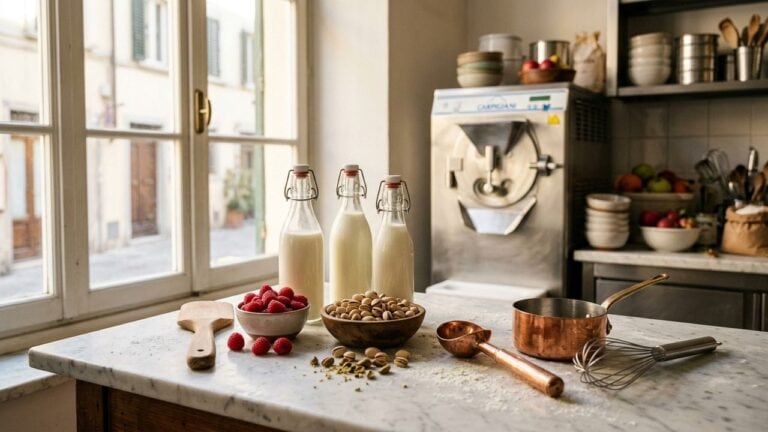
First, raw material quality. Serious gelato uses fresh local milk (ideally low-temperature pasteurized cow’s milk), seasonal fresh fruit, and artisanal paste for dry flavors such as Bronte pistachio, Piedmont hazelnut, or single-origin chocolate. A glaceria using ready-made industrial premix will produce a flavor that is identical from one city to the next — a strong sign that local character has been lost.
Second, texture density. Authentic gelato has an overrun of 25–35%, far lower than industrial ice cream which can reach 50–100%. When you scoop it, authentic gelato feels heavy on the spoon, dense, and elastic. If the scoop feels light and puffed up, it is closer to the ice cream category — not real gelato.
Third, serving temperature. Gelato is served at -12°C to -14°C, not -18°C like a home freezer. The right temperature allows gelato to melt slowly on your tongue and release its aroma gradually. If the first spoonful feels « cold-biting » and hard, the storage temperature is likely too low — usually a sign the glaceria is using a regular freezer rather than a dedicated pozzetto display cabinet.
Fourth, flavor clarity. A serious pistachio gelato will taste like pistachio — lightly bitter, savory, with a deep roasted nut aroma. A non-serious pistachio gelato will taste like « sweet green » with added coloring. Simple test: try a standard flavor (fior di latte, vanilla, or pistachio) at each glaceria. If the flavor lingers and is not buried under sweetness, you are dealing with a serious product.
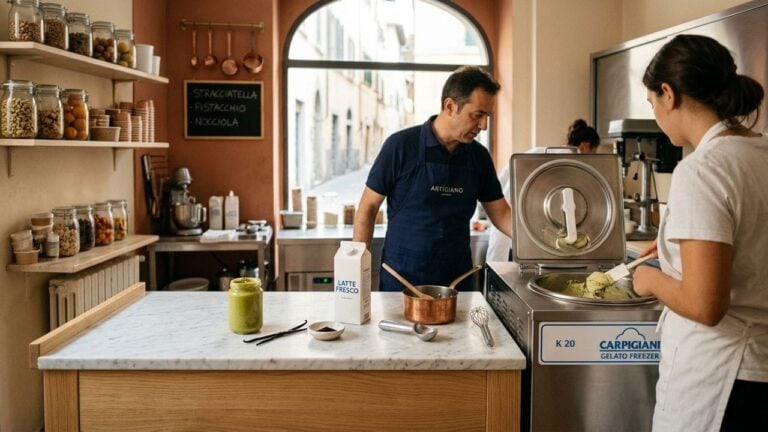
Fifth, production frequency. A truly artisanal glaceria makes gelato every day in small batches. You can peek into the production kitchen or ask the staff — they are usually proud to answer. A glaceria whose stock lasts for days typically uses industrial stabilizers to prevent texture breakdown — technically legal, but far from artisanal philosophy.
Note from Mr. Jeff — Recipe & Method Creator
« The best gelato is not the sweetest or the creamiest — it is the most honest. You should be able to taste the main ingredient: pistachio should taste like pistachio, mango should taste like mango. If your palate only registers sugar and fat, that is no longer artisanal gelato. »
Authentic Gelato vs Industrial Ice Cream — A Fundamental Difference That Shapes the Experience
Many consumers in Indonesia still equate gelato with premium ice cream. In reality, the two are technically distinct products from composition to serving method. Understanding this difference will immediately change how you evaluate a glaceria.
Gelato is an Italian artisanal product dating to the 16th century, made with low milk fat (4–9%), low air content (25–35% overrun), a relatively « warm » serving temperature (-12 to -14°C), and typically produced daily in small quantities. Industrial ice cream is a 19th-century American product, made with high milk fat (14–25%), abundant air (50–100% overrun), storage temperatures of -18°C to -20°C, and designed for mass production and long-distance distribution.
The impact on your eating experience is real. Authentic gelato melts slowly on the tongue, releasing the flavor of the main ingredient gradually, and does not leave a fatty coating that dulls the palate. Industrial ice cream feels more « cold-biting », creamier in texture, but the flavor tends to be flatter and dominated by sweetness and fat. If you taste pistachio from both categories back to back, the difference will be immediately clear — and usually there is no going back.
For a deeper technical look at the seven fundamental differences between these two products, we have a dedicated guide covering composition details, temperature, calories, and origins. You can read our guide on the difference between gelato and ice cream to understand the full picture — this knowledge will help you evaluate any glaceria you visit.
How to Recognize a Truly Artisanal Glaceria When You Visit
Once you understand the criteria, the next step is learning to read a glaceria within the first few minutes. Several visual and operational indicators are effective enough to distinguish a truly artisanal glaceria from one that simply uses a premium label.
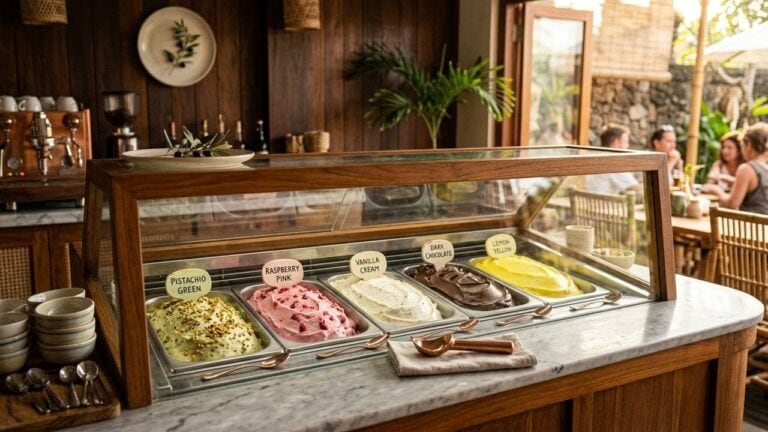
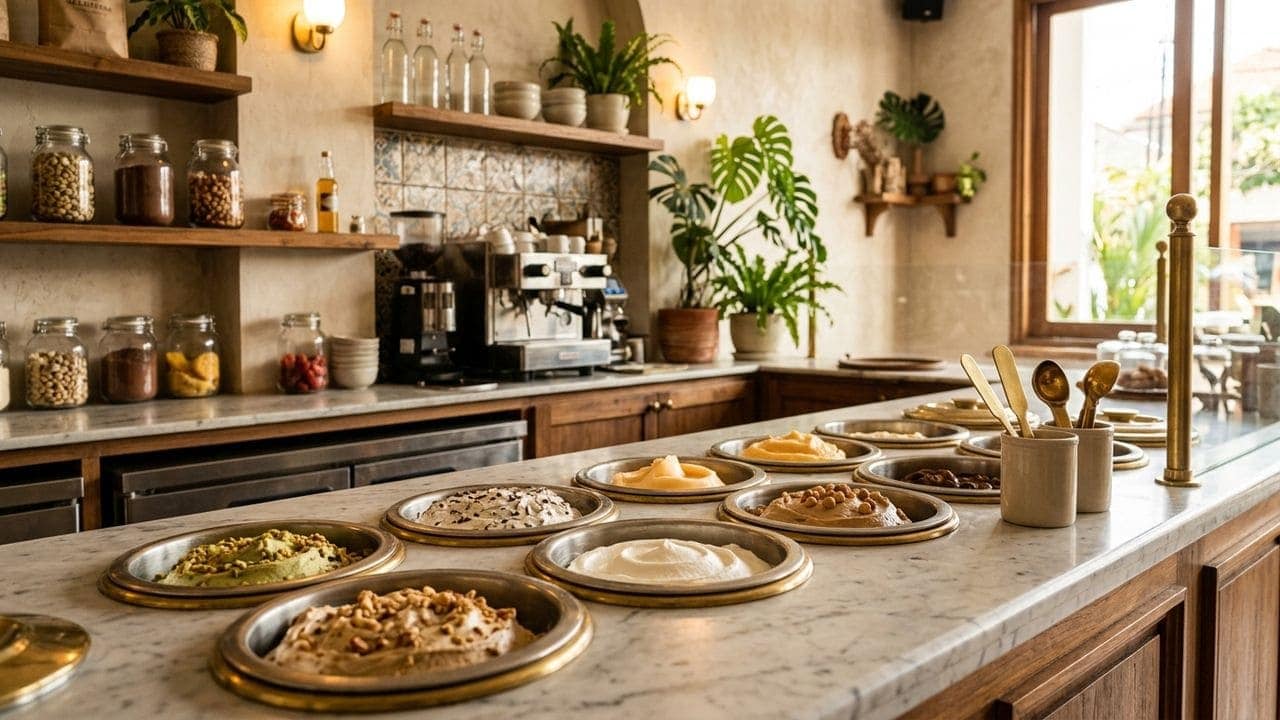
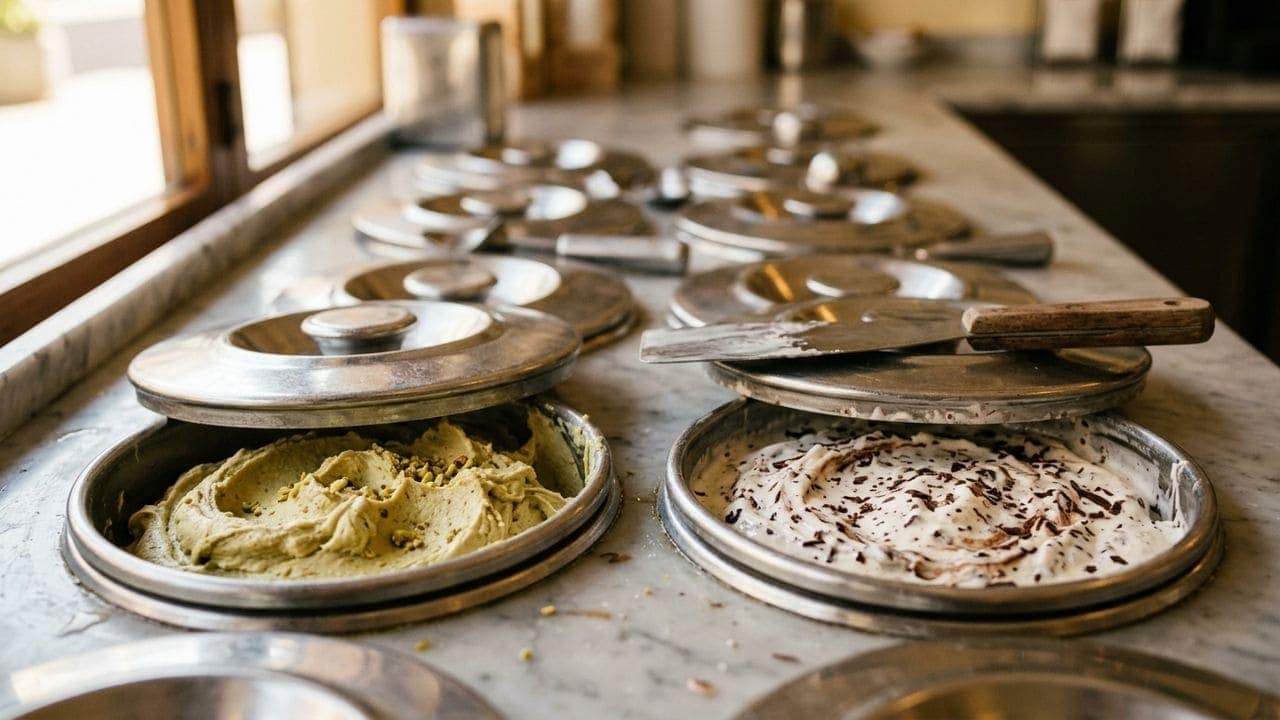
Green flags — signs of a truly artisanal glaceria: the display case uses stainless steel pozzetto cylinders (closed cylinders, not long open trays); a limited number of flavors (12–24 varieties, not 50+); gelato colors tend to be pale and natural (pistachio is light green, not neon green; mango is muted orange, not fluorescent yellow); an information board explaining the origin of ingredients or the production method; some flavors occasionally sold out with a « back tomorrow » note — a sign of limited daily production.
Red flags — signs the product comes from industrial premix: very bright, highly saturated colors across all flavors; flavors that should be seasonal (citrus, mango, strawberry) are available year-round with consistent quality; texture is very puffed and light when scooped; a menu of more than 40 permanent flavors; uniform pricing across all flavors including those that should be premium (Bronte pistachio is always more expensive at serious glacerie because the paste price is high); no information about ingredient origins or production frequency.
The simplest test to close your assessment: order one scoop of a standard flavor (fior di latte, vanilla, or pistachio) with no toppings. If the base flavor is clean, intense, and the main ingredient is clearly present, you are dealing with a serious glaceria. If the base is flat and needs toppings or sauce to become interesting, you have found the typical premix product sold under an Italian label.
Yogyakarta — A Growing Artisanal Gelato Scene with Its Own Identity
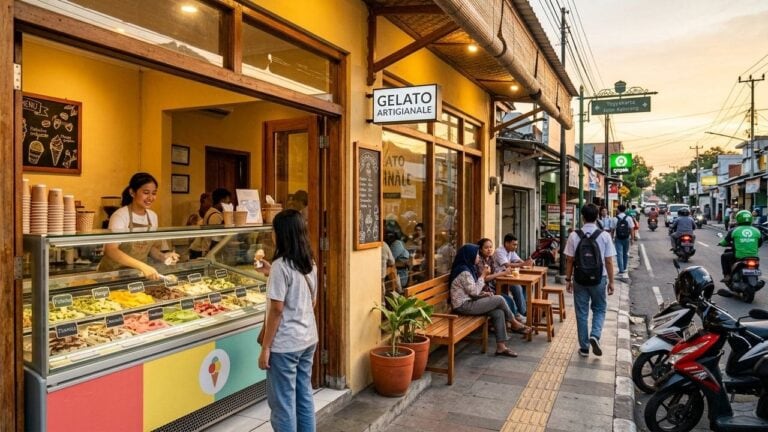
Yogyakarta has become one of the cities with the most vibrant gelato scenes in Indonesia, and this is no coincidence. The city has a large international student population, a community of long-stay visitors familiar with European food culture, and a constantly expanding ecosystem of cafés and creative spaces. As a result, several glacerie in Yogyakarta have reached a level of maturity where Italian gelato enthusiasts recognize the product as authentic.
One of the most talked-about is Tempo Gelato, which has several branches in the Prawirotaman, Kaliurang, and Taman Siswa areas. The dining experience there — from the Italian café interior, to the pozzetto display, to the consistency of texture and flavor — makes it a reference point when people discuss gelato in Yogyakarta. For first-time visitors, Tempo often serves as the entry point for understanding what an artisanal gelato experience really feels like.
Beyond that, Yogyakarta has Gelato Matteo, well known within the dessert enthusiast community, along with several small cafés and culinary studios that feature gelato as part of their menu. The general character of Yogyakarta’s scene is an openness to local flavor experimentation — some glacerie incorporate Indonesian flavors such as durian, young coconut, or avocado into their menu, while still using Italian artisanal technique.
If you are visiting Yogyakarta specifically to explore the gelato scene, one practical tip: plan your visits with breaks in between. Tasting too many flavors in one day will fatigue your palate and prevent you from detecting nuances. Two scoops in the morning, a lunch break, then one scoop in the afternoon — that is how Italians enjoy gelato every day.
Interested in Learning to Make Authentic Gelato Yourself?
Once you know what makes gelato worth calling « the best », the logical next step is learning to make it yourself. La Gelato Academy offers a complete course starting from Rp1.250.000 (regular price RP3JT), including lifetime access and 3 free base sachets shipped anywhere in Indonesia.
Bali — Premium Gelato in the Heart of International Tourism
Bali has a structural advantage that no other city in Indonesia can match: a constant flow of international tourists already familiar with authentic gelato in Europe. As a result, several glacerie in Sanur, Seminyak, Canggu, and Ubud have reached a level where their product is comparable to mid-range glacerie in Italy.
Several names that regularly come up in conversations within Bali’s gelato enthusiast community include Massimo Gelato in the Sanur area — often recognized for the consistency of its classic Italian flavors and the cleanliness of its production technique; Gaya Gelato with several locations in Ubud and surroundings; Pesca Gelato as an alternative focused on premium flavors; and Iconic Gelato & Bistro, which combines the glaceria concept with an Italian bistro experience.
The character of Bali’s scene differs somewhat from Yogyakarta’s. Because the primary market is short-stay tourists looking for a premium experience without lengthy explanations, glacerie in Bali tend to invest in interior design, packaging, and presentation. Technical quality is usually high, but prices follow suit — a scoop in Sanur or Seminyak can cost twice as much as in Yogyakarta for a technically equivalent product.
Practical advice for Bali: if you are staying for several days, intentionally visit two different glacerie on different days and order the same standard flavor (say, pistachio and stracciatella) at each. You will quickly map which glaceria fits your taste. There is no universal « best » — only the glaceria that works best for you.
Jakarta and Other Major Cities — Gelato in an Urban Environment
Jakarta presents different challenges and opportunities. The city has a large consumer market with high purchasing power, but also fierce competition from many international dessert concepts that are not always authentic. Some glacerie in Jakarta are serious — others simply use the « gelato » label as marketing without technical substance.
One name frequently mentioned in South Jakarta is Vilo Gelato in the Senopati area, known in the urban dessert enthusiast community for its dense texture and consistent flavors. Beyond that, several boutique glacerie in Kemang, Menteng, and PIK serve the premium market with solid technical quality. The key in Jakarta is to do your research first: read recent reviews, check comments from gelato enthusiasts in online communities, and taste before committing to a favorite.
Outside Jakarta, cities such as Bandung, Surabaya, Semarang, and Malang are also developing their gelato scenes. The pattern found is usually the same: one or two technically serious glacerie, surrounded by many operators using industrial premix with a premium label. The criteria you have already learned in this guide apply universally — you can use them in any city in Indonesia.
For readers based in tier-2 or tier-3 cities where no artisanal glaceria can be found nearby, this can actually be a signal of opportunity. Demand for authentic gelato in Indonesia far exceeds the current supply, especially in cities with a growing middle class. We will return to this point at the end of the guide.
Tips for Getting the Best Gelato Experience When You Visit
Understanding the theory is one thing; enjoying the maximum experience is another. Here are some practical tips that will immediately change how you explore a glaceria.
Arrive early in the production day. A truly artisanal glaceria makes gelato in the morning and sells it until stock runs out. Arriving between 11 a.m. and 2 p.m. usually means you are tasting a product whose texture has just finished setting — the best experience. Arriving near closing time means tasting a product that has been in the display case for hours.
Start with a standard flavor. Before trying unique or experimental flavors, order one scoop of fior di latte, vanilla, or pistachio. These are « naked » flavors that immediately reveal a glaceria’s technical quality. If the base is strong, the experimental flavors will usually be strong as well. If the base is weak, all other flavors will be masked by sweetness and texture alone.
Avoid excessive toppings on your first visit. Chocolate sauce, sprinkles, and biscuits are enjoyable, but they cover the flavor of the gelato underneath. On your first visit to a glaceria, order without toppings — you need to evaluate the product on its own terms.
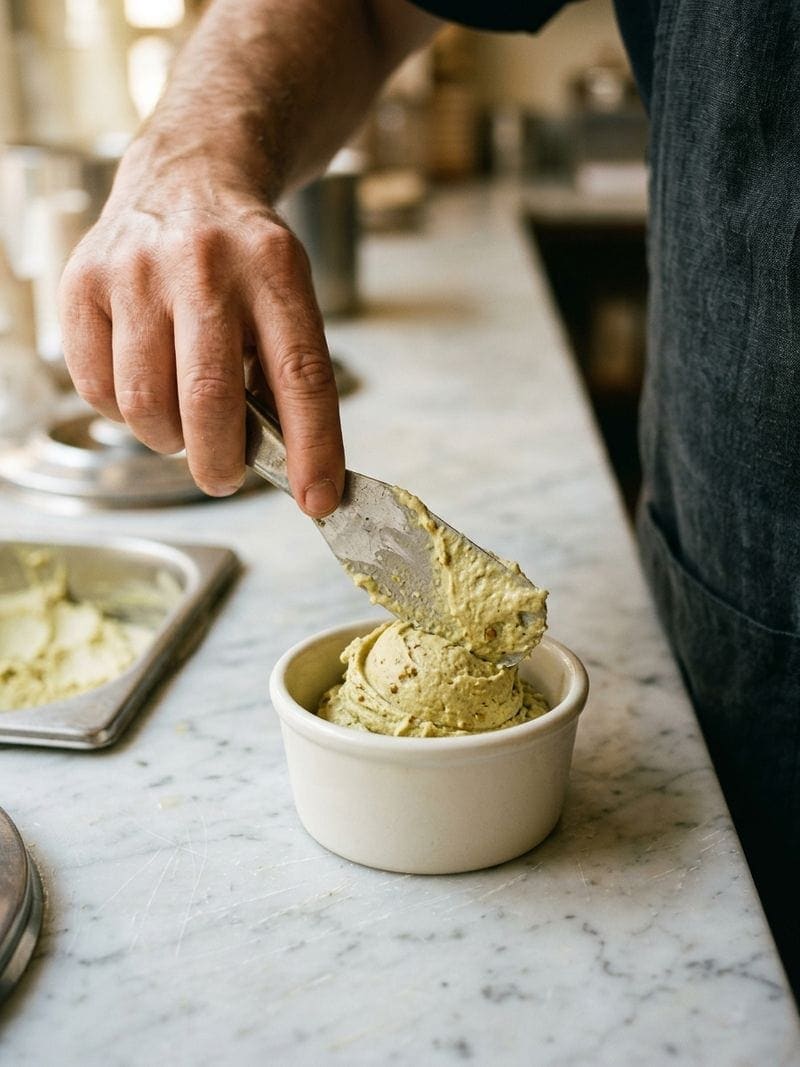
Watch how the scoop is made. A serious gelatiere uses a dedicated spatula and scoops with a sweeping motion (not a ball shape like American ice cream). This motion preserves the dense texture of gelato. If staff scoop with a hard digging motion and the gelato clumps, it is usually a sign the product is not dense enough or the temperature is not ideal.
Pay for experience, not volume. Authentic gelato does not come in large portions. A standard scoop in Italy is around 50 grams. A glaceria in Indonesia offering large portions at a low price is typically using industrial premix with high overrun. It is better to pay Rp 35,000 for one authentic scoop than Rp 25,000 for two industrial ones.
Note from Mr. Jeff — Recipe & Method Creator
« If you really want to understand gelato, stop asking for chocolate sauce on top. It closes off your palate. Once you get used to tasting pristine gelato, you will know which glaceria is serious and which one is hiding its flavor behind sauce. »
From Connoisseur to Creator — Making Authentic Gelato Yourself in Indonesia
At this point, you may be wondering: if authentic gelato is so specific and rare, why are there not more artisanal glacerie in Indonesia? The answer is not that the market does not exist — it clearly is growing. The answer is that the technical knowledge is not widely available in Indonesia.
Most dessert business operators in Indonesia still rely on industrial premix or recipes roughly translated from American sources. The result is a product that is technically legal to call « premium ice cream », but far from Italian gelato standards. Making the leap to the artisanal category requires an understanding of ingredient ratios, overrun principles, temperature management, and the philosophy of daily small-batch production.
La Gelato Academy was created to fill this knowledge gap. We offer a complete curriculum based on the cold process method adapted for Indonesia’s tropical climate, standard PLN 3.2 kW residential electricity, and local raw materials available in your market. The devise we uphold: Innovation without pasteurization. No temperature gap — a more hygienic, more efficient product, through a lightning process.
For those who want to explore the practical side of making gelato and ice cream at home or in a small lab, we have prepared two separate technical guides: how to make ice cream from a home recipe all the way to authentic Italian gelato and a guide to ice cream machines for an Italian gelato business. For those thinking further toward business, two paths are available: formal training at La Gelato Academy via our gelato course guide for Indonesia or the ice cream course as an entry point; and the business partnership path via the La Gelato franchise system with ongoing raw material support.
Frequently Asked Questions About the Best Gelato in Indonesia
What makes a gelato objectively « the best »?
Gelato quality is assessed on five criteria: raw material quality (fresh local milk, artisanal paste), texture density (overrun 25–35%), serving temperature (-12 to -14°C), flavor clarity (the main ingredient is clearly perceptible without being buried under sugar or fat), and production frequency (daily in small batches). The combination of all five criteria is what distinguishes artisanal gelato from premium ice cream wearing an Italian label.
What is a fair price for one scoop of authentic gelato in Indonesia?
A fair price ranges from Rp 28,000 to Rp 55,000 per scoop depending on the city and the flavor. Authentic Bronte pistachio is typically more expensive because the paste price is high. In Bali’s tourist areas, prices can reach Rp 60,000 per scoop. If you find gelato below Rp 20,000 per scoop claiming to be « authentic Italian », be wary of industrial premix use that keeps production costs down.
How do you tell authentic gelato from premium American ice cream?
Three quick indicators: milk fat content (gelato 4–9%, ice cream 14–25%), overrun or air content (gelato 25–35%, ice cream 50–100%), and serving temperature (gelato -12 to -14°C, ice cream -18 to -20°C). When scooped, gelato feels heavier and more elastic; in the mouth, gelato melts slowly and the main ingredient’s flavor is clear. Ice cream tends to feel lighter, « cold-biting », and dominated by the taste of milk fat.
Which city in Indonesia has the most mature gelato scene?
The three cities with the most vibrant gelato scenes are Yogyakarta (international student community and creative cafés), Bali (a constant flow of international tourists familiar with European gelato), and Jakarta (a large consumer market with high purchasing power). Each city has a different character: Yogyakarta tends toward experimentation with local flavors, Bali tends toward premium products with investment in presentation, Jakarta tends to be competitive with many boutique options. Cities like Bandung, Surabaya, and Malang are also developing.
Can a glaceria with many permanent flavors still be called artisanal?
That is difficult. The Italian artisanal philosophy is to produce few varieties at high quality, with some seasonal flavors. A glaceria with 40+ permanent flavors typically depends on industrial premix — it is technically impossible for one small lab to prepare 40 fresh flavors daily. This does not automatically mean the product is bad, but the « artisanal » label in this context is more a marketing claim than an accurate description of the actual production method.
How can I learn to make authentic gelato myself in Indonesia?
La Gelato Academy offers a complete curriculum based on the cold process method adapted for Indonesia’s tropical climate. Package 1 (Rp1.250.000 (regular price RP3JT)) gives you lifetime access to online materials plus 3 free base sachets shipped anywhere in Indonesia. Package 2 adds a 1-on-1 hands-on workshop in the Yogyakarta laboratory. 7-day money-back warranty — if you have not attended the hands-on workshop and have not completed more than 30% of the online materials.
Still Not Sure How to Start Your Gelato Journey?
Before committing, contact La Gelato Academy for a free 15–30 minute conversation about your interests and plans — whether you simply want to understand gelato more deeply, or are thinking about opening your own business. We will help you find the path that best fits your situation and budget — no pressure, no commitment.
Free consultation — No commitment — WhatsApp fast response
Conclusion — the best gelato is the one you understand. Looking for « the best gelato in Indonesia » as a definitive ranking will always disappoint — this scene is too alive and constantly evolving, with new glacerie appearing every year in Yogyakarta, Bali, Jakarta, and tier-2 cities. What is more useful is having a framework that lets you assess for yourself wherever you are: the five quality criteria, the difference between gelato and ice cream, the visual indicators of an artisanal glaceria, and the experience tips you have learned in this guide.
Once you understand what makes a gelato worthy of the name authentic, two things happen. First, your experience as a consumer becomes richer — you are no longer paying a premium without knowing what you are getting. Second, if you are thinking about building a business in the premium dessert category, you know the standard you need to reach to become a serious alternative in the Indonesian market. The philosophy of La Gelato Academy is simple: Innovation without pasteurization. No temperature gap — a more hygienic, more efficient product, through a lightning process.
Whether you want to remain a more discerning gelato enthusiast, or you feel driven to become a creator of authentic gelato in your own city, this guide is one starting point. The next choice is yours.
About the Creator
Mr. Jeff
Italian-trained glacier with years of hands-on experience. He developed all the recipes, methods, and production procedures at La Gelato — including the proprietary cold process method adapted for Indonesia’s tropical climate. Every formulation was developed by Mr. Jeff over months in the Yogyakarta laboratory before being integrated into the curriculum.
The philosophy he brings to the curriculum is simple: knowledge shared honestly is the path to a sustainable business. Every recipe taught at La Gelato Academy has been dogfooded — tested for months in our own laboratory before reaching course participants.
Mr. Jeff applies the same approach across the entire La Gelato ecosystem: the training academy (lagelatoacademy.com), the B2B raw materials factory, and the franchise program (la-gelato.com). Every component of the system on offer has been proven in practice before being shared with the community.